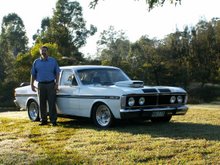
Number crunching
I am not going to produce a chart for the numbers as that is available elsewhere on the internet. Instead, there seem to be some rules for the XE V8’s that are worth following.
Allowing for wagon variants, there were three distinct XE model lines offered with the V8; the Falcon GL, the Fairmont and the Fairmont Ghia. Wagons were offered in both Falcon GL and Fairmont models. The V8’s were split between 4.9’s and 5.8’s. And there was a specific model sold only to the police. Here are the varieties and total figures:-
Falcon GL 5.8 - sold to the public and the police - 423
Fairmont Ghia 5.8 - sold to the public as an ESP - 178
Falcon GL sedan 4.9 - police only - 43
Falcon GL wagon 4.9 - 139
Fairmont sedan 4.9 - 64
Fairmont wagon 4.9 - 345
Fairmont Ghia sedan 4.9 - 1197
Remembering that there were a total of 2389 XE V8’s we can see that almost half, 1197, were Fairmont Ghia sedans with the 4.9 engine. Included in this total are 360 ESP’s. We can also see that the police liked the big V8.
There are a couple of other conventions which we need to mention:-
All of the 5.8 powered Falcon GL’s sold to the public were four speed manuals, and all of the 5.8 powered Fairmont Ghia ESP’s were manula cars as well. The only automatic 5.8 powered cars sold were the Option 36 police package cars. By historical convention, the police preferred gving their officers automatic cars. However, there are examples of police spec manual cars. It would also appear that the automatic used behind the 5.8’s was the old FMX gearbox.
With regard to the 4.9 powered cars, while exact figures for the police Falcon GL are not known - there may be the odd manual trans car - every one had an automatic transmission, the C4, except for 100 Fairmont Ghia ESP’s which had a manual gearbox. Until someone produces GL figures, or a survivor car, these ESP’s were the only manual 4.9 XE’s produced.
Showing posts with label ESP. Show all posts
Showing posts with label ESP. Show all posts
Tuesday, March 17, 2009

Saturday, March 14, 2009
The "Last" V8s Part 2
Figures show that Ford registered 66,849 Falcon/Fairmonts in 1982. Figures also show that of these, 3340 were V8 powered. That is almost exactly 5%. This is a far cry from the early years of the Cleveland V8, for example, 1972 when of 77,093 XA Falcons, 23,150 were powered by the ‘new’ Cleveland V8. This is almost exactly 30%.
The six/V8 percentage figures seem to have dropped off dramatically in 1977, perhaps as a result of the improved cross flow headed six, and then plunged even more in 1980, when yet again, improvements were made to the six, this time the fitting of the alloy cylinder head. The V8’s problem may not so much have been a falling out of love with the V8 as a falling in love with the improving six.
While some of the above figures cannot be completely relied upon, and it should be remembered that 1982 Falcon/Fairmont registration figures include the last months of XD production, the figure for XE’s fitted with V8’s is known:- 2389.
You would expect that there may be some logic to how Ford fitted their V8’s to the last Falcon’s. But then again, if you have been working your way through this site, you will find that there was little logic to much of what Ford did with regard to their cars.
To understand the V8 XE’s you have to first understand that Ford built cars for the general public, and they built cars for their greatest fans, the police. By the time the XE came along, Australian police forces were very comfortable with their big, V8 powered interceptors/chasers. Hence a proportion of the V8 powered cars went to them.
Ford were also keen to use V8’s in the XE station wagon as they appreciated that many of their wagon customers needed the extra torque inherent to the V8.
And Ford also knew that they had customers who wanted big, fast, sporty optioned V8 powered cars. And for them, they refined and sold their ESP’s.
The six/V8 percentage figures seem to have dropped off dramatically in 1977, perhaps as a result of the improved cross flow headed six, and then plunged even more in 1980, when yet again, improvements were made to the six, this time the fitting of the alloy cylinder head. The V8’s problem may not so much have been a falling out of love with the V8 as a falling in love with the improving six.
While some of the above figures cannot be completely relied upon, and it should be remembered that 1982 Falcon/Fairmont registration figures include the last months of XD production, the figure for XE’s fitted with V8’s is known:- 2389.
You would expect that there may be some logic to how Ford fitted their V8’s to the last Falcon’s. But then again, if you have been working your way through this site, you will find that there was little logic to much of what Ford did with regard to their cars.
To understand the V8 XE’s you have to first understand that Ford built cars for the general public, and they built cars for their greatest fans, the police. By the time the XE came along, Australian police forces were very comfortable with their big, V8 powered interceptors/chasers. Hence a proportion of the V8 powered cars went to them.
Ford were also keen to use V8’s in the XE station wagon as they appreciated that many of their wagon customers needed the extra torque inherent to the V8.
And Ford also knew that they had customers who wanted big, fast, sporty optioned V8 powered cars. And for them, they refined and sold their ESP’s.
Wednesday, February 14, 2007
Falcon ESP - Ford's Sleeper


 The V8-powered Ford XE ESP option offers enthusiasts a rare and solid performance package
 First published: Unique Cars issue #243, January 2005
Words: Cliff Chambers
Just what was Ford thinking in 1980 when it added a 'European Sports Pack' to its range of big, boofy, blokey XD Falcons? The XD that arrived in 1979 was viewed by many buyers – including plenty of disenchanted Holden enthusiasts – as the last bastion of genuine Aussie family car design.
With Chrysler's Valiant a generation too ancient, Ford had the market for large family and fleet car sales virtually to itself and emphasised its all-Australian credentials in the war against GM-H's European-designed Commodore. Although Ford hadn't bothered to include a purpose-built performance model in the XD line-up, some creativity with the options list could create a car packed with performance and comfort items and for less money than the ESP 5.8's $14,000 asking price.
At release, the XD ESP was based on the taxi-like GL model – replacing that car's vinyl trim with horizontally-striped Scheel sports seats, adding five-spoke Globe alloy wheels, uprated suspension, a rear axle tramp rod, faster ratio unassisted steering and some creative pin-striping. Ford's intention was an apparent reincarnation of the GT model it had dumped five years earlier, but very few buyers or motoring writers made the connection. Preview evaluations gave the car a 'could try harder' and magazines from that point on had difficulty extracting an ESP-equipped XD from Ford.
Six months later, in January 1981, the 'proper' ESP arrived with Fairmont underpinnings and the choice of 4.1-litre or 5.8-litre engines, automatic or four-speed manual transmission plus a substantial boost in credibility. 1982 brought with it the XE Falcon range, a vastly-improved ESP and the appalling news that Ford was to discontinue V8 production in Australia. Improvements to the XE included a new Watts Link system of rear axle location that was claimed to deliver similar levels of grip and stability as independent rear suspension. Cars powered by the 5.8-litre engine received a 28-spline, four-pinion limited-slip differential and four-wheel disc brakes were standard to all ESPs.The interior was remodeled, using colour-keyed Scheel seats with matching door trims.
Full instrumentation and a four-speaker Philips sound system, with graphic equalizer, were complemented by normal Fairmont Ghia features, including electric windows and central locking. Replacing the XD model's Globe wheels were specially-machined, gold-painted alloys that have become widely known as 'snowflake' wheels.
ESP XE buyers were offered a choice of three engines; the 4.1-litre six – fuel injected from early 1983 – plus 4.9 and 5.8-litre V8s. By the time XE versions arrived on showroom floors, supplies of the larger engine were growing thin and very few 5.8-litre cars were built. According to Jay Cutajar, who maintains a very useful website devoted to ESP Fords, auto transmission was never officially offered in conjunction with the 5.8-litre engine, but cars with this combo were certainly built to special order.
Mick Olsen's parents were among the lucky recipients of a V8-engined ESP and, 20 years later, he was able to renew the acquaintance via a very rare Burnt Orange 5.8-litre, four-speed."As a young fella, my parents had one and when this car came along with such low kilometres and the 351/manual combination I jumped at it," admitted Olsen, whose garage provides lodgings for a variety of high-performance Ford and Holden models. "Compared to, say, an XA GT, it's just a very smooth, comfortable car to drive," he said. "Then, of course, you've got the reliability – every time you jump in it starts and it doesn't have any rattles. I've had it about three years and nothing has gone wrong."
Within weeks of Olsen's car departing the production line, Ford turned its deafest ear to the wailing from disgruntled performance addicts and discontinued public sale of V8-engined ESP Falcons. That was in November 1982, and it was four months before a replacement, in the form of a fuel-injected version of the 4.1-litre, six-cylinder was announced. Cutting weight by almost 120kg helped offset the loss of 40kW and enhanced the EFI's economy by around 30 per cent when compared with a 5.8-litre. With the arrival of its XF Falcon in 1984, Ford discontinued the ESP.
ON THE ROAD
Take away the soft and cuddly Scheel seats, with their matching fabric door trims, and the inside of an XE ESP looks little different to any other Fairmont of its era. The big, plastic steering wheel seems very un-European and then there's that under-dash handbrake that looks like – and is – a throwback to the 1960s. With power assistance adding to its inherent vagueness, the recirculating ball steering isn't a patch on a good rack and pinion system. However, with 2.6 turns lock-to-lock, it allows the driver to respond quickly if the rear end steps out of line. That kind of behaviour is most likely to occur on wet, loose or bumpy surfaces – none of which are particularly friendly to a rear axle known unkindly in the motor trade as 'Watts Dancing'. Providing the car hasn't been flogged to the point where its springs and shocks have turned to jelly, a big-engined ESP feels great on relatively smooth bitumen and can be pushed exuberantly through the majority of corners.
Four-wheel disc brakes are standard and well matched to the car's performance and 1560kg bulk. While Borg-Warner's four-speed isn't the worst manual gearbox in the world, buyers who intend using their ESP as daily transport might be better served by choosing an automatic.In this era of fuel price rises, the 80-litre tank costs close to a day's pay to fill and will be empty after 500 kilometres of gentle highway running. Performance testing of a new 5.8 by Wheels magazine stopped the 0-100km/h watch at 8.9 seconds and revealed a top speed of 194km/h. In-gear acceleration was pretty average for a car with that many litres under the bonnet – the critical 80-110km/h overtaking increment taking 6.8 seconds, which is 2.7 seconds slower than a 4.0-litre AU Falcon Forte.
Fitting exhaust extractors and dual pipes will improve engine efficiency and fuel economy.Those looking for better fuel economy might seek out one of the post-1982 EFI cars. With 90 fewer Newton-Metres of torque than a 5.8, the injected ESP won't perform with the V8's bravado, but 9.5 seconds for 0-100km/h isn't slow and 12L/100km fuel economy is achievable in highway running.
BUYING
Exclusivity has driven ESP values steadily upwards during the past decade and few Australian cars offer greater exclusivity than a four-speed 5.8-litre XE ESP. Less than 180 were built and cars showing fewer than 50,000 kilometres frequently top $20,000. Colour is significant to the value of these cars, with charcoal or silver examples typically $2000-4000 more expensive. More common are XE 4.9-litre automatics – those in decent, rather than pristine condition normally priced below $8000. Manual transmission in conjunction with the 4.9-litre engine is difficult to find – only 100 were made – and these cars are likely to cost 50 per cent more than an automatic in similar condition. Six-cylinder EFI cars are scarce and very good ones can reach $7000. Carburettor-fed XD or XEs can be found at less than $5000.
Subscribe to:
Posts (Atom)