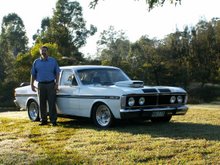
Following the sales success of both the XR and XT GTs, Ford Australia decided that the GT would continue in its upcoming model and in May 1969, production of the XW GT - flagship of the XW Falcon range - commenced. However the new GT was a far cry from the relatively subdued XT GT.
The new model was much bolder and meaner looking, with a new front and rear end treatment, a large range of striking colours, blackouts around the doors and on the bonnet, bonnet scoop, driving lights, chrome strips, badges on the guards and boot lid, a big wide stripe down each side and a decal of a V8 powered kangaroo burning rubber, described as the Super Roo. The new GT certainly made an impact and was not the type of car for those looking for anonymity.
Mechanically, the 302 cu.in. V8 in the XT GT was initially replaced by the larger and more powerful 351 cu.in. version of the Windsor motor. This increase in size, along with compression being raised from 10 to 1, to 10.7 to 1, increased engine power from 230 HP at 4800 rpm to 290 HP at 4800 rpm and torque from 310 lbs/ft at 3800 rpm to 385 lbs/ft at 3800 rpm. To handle the extra power and torque, the XW GT received the venerable Ford 9 inch limited slip diff, running 3.25:1 gears. As with the XT GT, automatic transmission was also available in the XW GT, however the stronger FMX auto replaced the C4 auto of the previous model.
With the growing importance of the Bathurst race, a number of other changes were made to improve the XW GTs race winning potential. These included stiffer suspension, 11.25 in. ventilated front disc brakes and an enormous 36 gallon fuel tank - obviously to minimise fuel stops in the great race. Wheels and tyres were also upgraded to 6.0 in. wide Kelsey Hayes riveted ‘12 slot’ rims running ER 70 x 14 HR Dunlop SP or Olympic ‘Wide Ride’ radial ply tyres.
Although these changes made the new GT a much more performance oriented vehicle than it’s predecessor, the XW GTs increased weight ensured that its top speed (125-130 MPH) and quarter mile times (15.5-16.0 sec.) were very similar to those of the XT GT. Only in the 0-100 MPH times (20.3-20.9 sec) did the XW GT show its potential, being around 3 sec. quicker than the XT GT.
It is generally accepted that Windsor powered XW GTs were produced up until the end of February 1970, with total production up to this point being 1268 vehicles. The exact change over date for the Cleveland engine is however unclear and some may have continued into March 1970. At a cost of only $4250 incl. tax, the new GT was considered by ‘Wheels’ magazine, to be “the best performance bargain in Australia”.
As good as the new model was, the factory wanted something better to race at Bathurst and so an even more potent version - the XW GTHO - was developed.
THE GTHO
Production of the XW GTHO - with HO standing for Handling Option (not High Output) - commenced in July 1969. Changes from the standard model included replacing the cast iron inlet manifold and Autolite 450 cfm carburettor with a Ford (Buddy Bar) aluminium inlet manifold and 600cfm Holley carburettor (similar to the one used on the 390 Mustang GT), a bigger cam, heavy duty alternator, a 3 in. tailshaft, bigger front sway bar and a rear sway bar. For marketing reasons, Ford still claimed only 290 bhp for the GTHO - the same as for the standard XW GT, even though it was obviously more powerful. So special was the GTHO, that Ford gave it a different model number (18939) compared to the standard GT (18938). Interestingly, this convention was not carried through to the Phase 3, with the XY GT and HO of that year, having the same model number. More about the vagaries of model numbers for a later issue.
Although top speed for the GTHO (130 MPH) was similar to the standard model, how it got there was a vast improvement over the GT. The quarter mile times (14.4-15.0 sec.) show a dramatic improvement over the GT, with the 0-100 MPH times (16.7-16.8 sec) confirming its acceleration capabilities.
Having produced a 1-2-3 victory at the Sandown 3 Hour race only weeks before, great things were expected of the GTHO at Bathurst, on that first weekend in October. Everything looked good in practice and qualifying. The Geoghegan brothers took pole position with a time of 2:48.9 sec. - nearly 8 sec. faster than in 1968 - and the GTHOs were able to reach 136 MPH down Conrod Straight, compared to 130 MPH for the Monaros.
Unfortunately history shows that even the best laid plans can often go astray. Apart from a massive accident on the first lap, where Bill Brown rolled his GTHO coming off the top Skyline, the main thing that stopped a Ford victory on the day of the big race, was the selection of untried Goodyear racing rubber by the Ford works racing team manager Al Turner. A non-factory GTHO driven by running XAS Michelins almost took out the race and finished 2nd by only 44 seconds.
Where the Monaros were lapping in 2:55s, the GTHOs were lapping in 2:52s. Interestingly, Ford - quick to try to negate the effect of their loss to Holden - ran an advertising campaign which showed a photo of destroyed Goodyear tyres in front of a GTHO having its rear tyres replaced and with the caption "We were a little deflated".
Production of Windsor powered GTHOs stopped in December 1969 with a total of around 260 being built - making them one of the rarest GTs. Cost of the GTHO was only $4495 - just $245 more than the standard model - to ensure that it was still eligible for Class D ($3100-$4500) at Bathurst. If ‘Wheels’ considered the GT to be a bargain, then the GTHO must have been a steal.
Unfortunately, the original GTHO will always be remembered as the car that lost Bathurst, even though it was a winner on the road. Such was the demand for the GTHO, that in early 1970 - prior to the introduction of the Phase 2, Ford produced around 57 GTHOs using the Phase 1 running gear, but with a standard ‘Cleveland’ 351 4V engine. Commonly refereed to as Phase 11/2s, these are some of the rarest of the full production GTs.
The CLEVELAND
The ‘Cleveland’ designation for the 351 cu. in. motor fitted to XW GTs built from March 1970, comes from the location of the engine plant where they were originally assembled; Cleveland, Ohio, in the USA. (Windsor motors were assembled in
Windsor, Ontario, in Canada) Although having the same capacity, bore and stroke as the 351W, the 351C was a completely different motor, with completely different characteristics. Where the ‘Windsor’ was designed to be very robust and torquey, the 4V ‘Cleveland’ as used in the GT was designed more with outright performance (horsepower) in mind. Revised sizing of journals and extra large intake and exhaust valves and ports enabled the new motor to rev a lot harder than the previous one.
Mechanically, the 351C had an increased compression ratio of 11 to 1, provided peak power of 300 BHP at 5400 rpm (10 BHP more than the 351W at 600 RPM higher) and peak torque of 380 lbs/ft at 3400 rpm (5 lbs/ft less than the 351W at 400 RPM lower). With the extra power Ford decided to lower the diff ratio from, 3.25:1 to 3.00:1.
Apart from the engine, the only other obvious changes were to the tachometer (increased from 6000 RPM to 8000 RPM) and the oil pressure gauge (increased from 80 psi to 100 psi). Although initially fitted with the Kelsey Hayes riveted ‘12 slot’ rims, in May 1970 Ford introduced the Kelsey Hayes riveted ‘5 slot’ rims, still running ER 70 x 14 HR Dunlop SP or Olympic ‘Wide Ride’ radial ply tyres. Performance of the Cleveland powered XW GTs was similar to the Windsor powered ones. Although the change in diff ratios ensured a slightly higher top speed (130-135 MPH) for the Cleveland powered XW GTs, it also meant that acceleration figures remained fairly similar..
Having commenced in March, production of the Cleveland powered XW GTs continued on until some time in October 1970, with total production up to this point being around 1019 vehicles. With the production of XY falcons commencing in September 1970, it is interesting to note that some of the late XWs were fitted with XY radiator support panels whilst some early XYs were fitted with XW radiator support panels.
With the failure of the XW GTHO (Phase I) to win at Bathurst in 1969 (although not the fault of the car), Ford decided to go all out in developing its new Bathurst weapon, the Cleveland powered XW GTHO (Phase II).
THE GTHO (Phase II)
Production of the XW GTHO (Phase II) commenced in June 1970. Changes from the standard model included modifying the cast iron inlet manifold and replacing the Autolite 450 cfm carburettor with a Ford 750cfm Holley carburettor, a fairly lumpy solid cam with coresponding upgrades to the valve train, heavy duty alternator, a 31/2 in. tailshaft with larger universal joints, bigger front sway bar and a rear sway bar, revised front and rear spring rates, unique upper control arm and spindle to provide an increased front track, 31 spline close ratio gearbox, 3.50:1 diff with nodular iron housing and 31 spline axles and 21/2 in. wide and finned rear drums. For marketing reasons, Ford still claimed only 300 bhp for the GTHO - the same as for the standard Cleveland XW GT, even though it was much more powerful.
Even with the lower diff ratio, top speed for the new GTHO was improved (135-144 MPH). Although acceleration for the new GTHO was also a vast improvement over the standard GT the quarter mile times provided by the testers of the day were fairly inconsistent (14.2-15.2 sec.). Interestingly, these figures along with the 0-100 MPH times (16.7 sec) were almost identical to those of the Phase I. In fact the Phase I was equally as good as the Phase II in many respects, much to the surprise I’m sure, of a lot of you.
BATHURST 1970
Although Moffat provided a win in the Sandown 250 race only weeks before, mechanical problems plagued the rest of the HOs entered and this lack of reliability of the new HO provided some concern to the Ford camp in the lead up to Bathurst. But they should not have worried, as the mountain is a place where the Fords excel. As in 1969, everything looked good in practice and qualifying. The new GTHOs filled the first three positions on the grid, with Moffat taking pole with a time of of 2min 49.0sec.; surprisingly slower than Geoghegan’s time of 2 min 48.9sec. in 1969.
With the experience of 1969 behind them and no untried Goodyear racing rubber the factory GTHOs driven by Moffat and McPhee, ran faultlessly all day and although having a good battle with the XU-1 Toranas of Bond and Chivas, were able to make it a Ford 1-2 victory. Moffat also set a new Class E race lap record of 2 min 55.0sec, again slower than his Class D race lap record of 2 min 52.1sec set in the Phase I.
Official records indicate that production of the proper Phase II GTHOs stopped in October 1970 with a total of around 292 (not including the Phase 11/2’s) being built. Cost of the Phase II was only $4790 - just $425 more than the standard model.
With the push towards total performance, production racing wasn’t the only area of motor sport that Ford was interested in. With Ian (Pete) Geoghegan and Moffat having had a great deal of success in touring class racing with their Mustangs, Ford decided to develop their own car for improved production. The car that we all know of as the Geoghegan Super Falcon, actually started life as an XW GTHO. Two cars were originally built, with one for use by Moffat (see photos).
As can be seen from the picture of the engine bay, with the fuel injection pipes sticking up, this was a car that meant business. Ford spent a lot of money developing these cars, and although they proved to be very quick, they were unfortunately also a little unreliable.
Whilst the original GTHO will always be remembered as the car that lost Bathurst, the Phase II was the one that restored the faith in the Ford hierarchy of the benefits that could be achieved from an involvement in motorsport - “Win on Sunday, Sell on Monday”.
With success at the mountain and a new model (XY) being released to the public with rave reviews (especially the ‘Shaker’ XYGT), Ford could do no wrong. As good as the Phase I and II had been, Ford had something better waiting in the wings. In late 1970, the first XYGT buyers had the opportunity to get a taste for what was to come. They could order, as a $425 option, a Phase II engine for their XYGT. Now that would have been an interesting proposition.