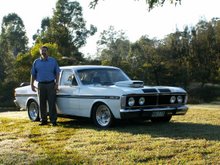
Showing posts with label XB. Show all posts

Thursday, July 30, 2009

Metric


With the introduction of the XB model, a decision was taken to fit dual scale speedometers with the mph reading still dominant, but with an inside reading in smaller yellow letters showing kph.

Friday, July 24, 2009

302 Cleveland

Later two barrel 302C’s fitted to XB Falcons adopted the large, ‘second’ style 4V air cleaners with non-belled mouth and non-tapered snorkel.


Sunday, May 31, 2009

Thorn Red 5

And here is the data plate.


Showing the Y422 paint code, and the 10/75 build date - although RJ in the VIN implies September, 1975 build. Either way, interesting, considering the 1975 Bathurst race was on 3rd, October that year.

Thursday, May 28, 2009

Thorn Red 4

Will has the following photograph.


Another www.autopics.com.au photo which appears to show ‘five’ racecars, but perhaps only one was real, and the rest were for promotion purposes for City Ford.

Or was Will’s car ordered by a devoted Moffat fan ?

Friday, May 22, 2009

Thorn Red 2

Perhaps the most famous, and continuing the success carried over from racing the XW and XY, was Allan Moffat who drove some quite awesome looking hardtops at Bathurst.

This is the car Allan Moffat drove in the 1975 Bathurst race.


And this is the XB hardtop that is privately owned.


The car is a 1975 XB Falcon 500 hardtop, fitted with a 302ci Cleveland V8, three speed automatic trans, and factory ordered GT/GS options - dash, steering wheel, bonnet, grille and rear wing.

Sunday, March 08, 2009

Cleveland 4V Engine


Quite a bit of discussion and research has gone into the 4V Cleveland engine issue. The main issue is that Ford Australia called all it’s GT Cleveland engines 4V’s to represent the 4 venturi carburettor fitted as standard to XW-XB GT’s.

The imported US Cleveland’s were all fitted to GT’s with the large port 4V heads whereas the Australian built Cleveland’s were all built with small port heads known as 2V’s but retained the 4V designation due to the Australian 4 venturi manifold with small port inlets.

To identify the imported engine in the 1970-1972 cars is that they have a D block casting on the top passenger side of the block and a coil tag identifier & tappet cover sticker of CK608 for Manuals and CK609 for Automatics.

The heads have a 4 stamped in the top corner. In late 72 and 1973 cars they have a square block casting on the top passenger side of the block and a coil tag identifier of CK617 Manual only. The heads have a 4. (dot) stamped in the top corner.

Australian engines were fitted to automatics from mid 72 and manual GT’s from late December 1973. These engines are identified by the square block casting mark and small port heads with no coil tags. Ford Australia continued to import the large port 4V heads and many of these made there way onto the Australian engines for racing, press cars, dealer fitment, spare parts counter sales etc.

Australian engines carry the GF (Geelong Foundry) casting mark beside the oil pressure sender but the CF (Cleveland Foundry) casting mark is also found on later engine blocks. The CK617 imported large port square block engine was limited to the XA Manual GT’s and a small number of 1973 XB Manuals (72 coupes and 139 sedans).

Thursday, March 05, 2009

XB GT Specifications

Engine Specifications:

Type: 351 cubic inch (5.763 litre) Cleveland V8
Bore & Stroke: 102 x 89mm (4.00 x 3.50in)
Power (DIN): 224kW (300bhp) @ 5400rpm
Torque (DIN): 515Nm (380lb-ft) @ 3400rpm
Compression Ratio: 11.0:1
Configuration: Front mounted, longitudinal, 90 degree V8
Head Design: Pushrod & rocker OHV with hydraulic lifters
Fuel System: Ford Autolite '4300' 605cfm 4 barrel downdraught carburettor
Ignition System: Single point Autolite Distributor - changed to Motorcraft Oct 72
Exhaust System: Cast iron manifold, low restriction twin exhaust
Manual Gearbox :
Type: 4 speed all-synchronised
1st: 2.78:1
2nd: 1.93:1
3rd: 1.36:1
4th: 1.00:1
Reverse: 2.78:1
Automatic Transmission:
Type: 3 speed FMX
1st: 2.40:1
2nd: 1.47:1
3rd: 1.00:1
Reverse: 2.20:1
Rear Axle:
Type: 9in removable carrier type, Limited Slip 'traction lock' Diff, 28 spline
Ratio: Manual 3.00:1 or 2.75:1 (Optional)
Automatic: 2.75:1 or 3.00:1 (Optional)
Suspension:
Front: Independent angle poised ball joint, coil springs, shock absorbers, wishbones and anti-roll bar
Rear: Hotchkiss type with semi-elliptic leaf springs, shock absorbers and live axle

Brakes:
Front: 286mm (11.25in) Servo assisted discs
Rear: 254mm (10in) Servo assisted discs
Steering:
Type: Re-circulating ball power assistance (Optional)
Ratio: 16:1
Wheels & Tyres:
Wheels 6.0 x 14 Steel - Silver painted Steel '12 Slot'
Tyres E70HR14
Instrumentation:
Speedometer: 140mph or 240kmh
Tachometer: 7000rpm
Oil Pressure: Gauge
Water Temperature: Gauge
Fuel: Gauge
Voltage: Gauge
Ignition: Warning Light
High Beam: Warning Light
Brakes: Warning Light
Clock: Analogue
Dimensions:
Length: 4808mm (189.3in)
Width: 1969mm (77.5in)
Height: 1369mm (51.9in)
Weelbase: 2819mm (111.0in)
Front Track: 1524mm (60.0in)
Rear Track: 1524mm (60.0in)
Weight: 1587kg (3500lb)
Turning Circle: 12.0m (39.4ft)
Fuel Tank: 79.6lt (17.5gl) 122.9lt (27.0gl) (Optional)
Seating: 5
Performance:
Top Speed: 193km/h (120mph)
0 - 60mph (0 - 100 km/h) - 8.1 seconds
Standing 1/4 mile (400m) - 15.8 seconds

XB GT COLOUR CODE CHART
Paint Code Paint Name Total Paint Code Paint Name Total
X Red Pepper
280
M Yellow Blaze
262

3 Polar White
218
U Burnt Orange
164

V Apollo Blue
130
6 Mulberry
110

H Tropic Gold
89
P Emerald Fire
83

K Tango
69
B Onyx Black
65

2 Tropicana Green
57
E Sandstone Beige B (June, 1974)
42

R Copper Bronze metallic 41
7 Walnut Glow
34

9 Snow White (March, 1976)
28
Y Kelly Green
25

C Sky View Blue
23
9 Sandstone Beige A (November, 1973)
20

5 Deep Aqua
19
F Frosted Lime
14

T Outback Bronze
13
Z Sherwood Green Met.
13

4 Neptune Blue
9
C Antique Beige (March, 1976)
9

G Banana Blush
6
S Satin Brown Met. (May, 1976)
6

Y117 Brambles Red
6
L Mushroom Beige
5

Y113 Rothmans Blue
5
Y377/Z801 Ultra White
5

Y376 Sogo Port Wine
4
Y045 Corporate Blue
3

Y304 New Look Grey
3
A Blue Steel (May, 1976)
2

A Yellow Sand
2 Q Coolmint Green Met.
2
Y051 New England Green
2 Y356 Kwikasair Violet
2
Y390 Euclid Green
2 Y396 Lime Glaze
2
Z201 Light Orange
2 Z857Z857 Deep Ivy
2
Y120 Daimler Blue
1 Y138 Red Satin
1
Y154 Betta Primrose
1 Y161 Royal Umber
1
Y244 Pepsi Yellow
1 Y264 Fanta Orange
1
Y277 Vintage Burgundy
1 Y301 S.T.C. Yellow
1
Y308 Budget Green
1 Y314 Rothmans Filter Blue
1
Y324 Diamond White
1 Y340 Hughes Blue
1
Z192 Not Known
1

Monday, March 02, 2009

XB GT


Introduced in September, 1973 the XB offered a minor but succesful restyling of the XA, with its colour keyed bumpers and recessed grille offering a cleaner and tidier presentation.

The XB featured a slight restyle of the previous model, featuring a cleaner but more aggressive front end with a forward sloping bonnet and a wide set, 'egg-crate' split grille.

The design was very reminiscent of the 1971-73 U.S. Mustang. The tail lamps were also neatened.

The 351ci Cleveland V8 engine remained, now solely manufactured in Australia rather than imported and in a major development, four wheel disk brakes were fitted as standard.

The XB ran out the GT line, existing until June, 1976 after which there were no more GT's.

While it suffered from falling performance at the hands of emission regulations, it excelled in the Grand Tourer role, being comfortable and refined, with good handling, great brakes and V8 performance.

Only 1950 four doors were produced, and 949 hardtops, making the Falcon XB GT highly collectable today.

There is also considerable prestige associated with the fact that the XB GT was used as the basis for the black "Pursuit Special", or "The last of the V8 Interceptors", featured prominently in the Mad Max and Mad Max 2 films.

Today many car collectors consider them a true Aussie icon, and deservedly so! Even stock standard 1974 XB sedans, used as the basis for the blue and yellow "Police Interceptors" in the first Mad Max film, are today finding a new cult following.

Monday, September 15, 2008

Tuesday, September 09, 2008

Saturday, September 06, 2008

Bonnets


The pressings in the bonnet leading up to the scoops themselves are curved on the Mustang as above.

Whereas they are straight on the Falcon.


But, are the actual scoop inserts identical ? Anyone know ?

Wednesday, September 03, 2008

Bonnets

Anything else ? Well, yes.


The Mustangs bonnet release latches are far closer to the front of the bonnet than the Falcon’s, reflecting the difference in location of the radiator support.

Sunday, August 31, 2008

Bonnets

Back to the Mustang-Falcon comparison. Here are the bonnets.


Falcon


Mustang

The deep fore and aft ribs that separate the hoodscoops are further apart in the Mustang than in the Falcon and there is a more prominent crease line down the centre of the bonnet on the Australian car. The leading edge is more pointed so to accomodate the greater overhang of the Falcon’s bonnet in relationship to its grille.

Monday, August 25, 2008

Bonnets


However, it is intriguing and the generator of endless debate if you claim that the XB hardtop as being an amalgram of the front of a 71-73 Mustang and the rear of a 70-71 Torino.

Friday, August 22, 2008

Bonnets


There can also be seen that there was some influence from the US 1970/71 fastback Torino in the side profile shape of the hardtop Falcon’s rear side window.

Although it can be seen that the rearmost ‘break’ line in the glass is more angled, or nearer the horizontal, on the Falcon than on the Torino.

Tuesday, August 19, 2008

Bonnets

The XB Falcon is most often compared to the 1971-73 U.S. Ford Mustang. There was a perception that the front of the XA Falcon looked a bit ‘soft’ so the restyle to the XB was done to toughen the car up. Whether one looks tougher than the other is a matter of interpretation, but there is no denying that the restyle did bring the Falcon closer to a U.S. copy than before.

Or did it ?

A direct comparison, Falcon to Mustang.


It is apparent from the above that the Falcon is a wider car - although the 3 inches noted in specifications can most probably be attributed to the bulging rear wings - but it is also almost 4 inches shorter than the Mustang. The Falcon looks wider at the front due to the fact that the front wings stay much more square to the rest of the car in plan view, unlike the Mustang which squeezes inward to the front of the wings. This tends to push the headlights in closer together than in the Falcon.The Falcon also has much broader upper wing surfaces.

Saturday, May 03, 2008

Allan Moffat Special


There is some ‘history’ as to why the XB John Goss Special and was not an Allan Moffat Special, but it would appear that, for whatever reason, Allan Moffat was not available to promote the limited edition XB when Ford needed him to be and John Goss was.

Here is some information, supplied by Ford Australia, about the AMS.

The "Allan Moffat Special" Falcon 500 sedan was released in 1977 and was available in a limited run of 500 vehicles only.

The appearance of the "Allan Moffat Special" included a distinctive hood, bodyside and rocker panel black out exterior paint treatment similar to that of the XB GT.

Standard specifications of the vehicle were:

*Falcon 500 sedan
*4.9 litre V8 engine
*4 speed manual or T-bar automatic trans
*4 wheel disc brakes
*Limited slip differential
*Sports handling suspension
*Dual exhaust
*Driving lights
*Styled steel road wheels
*FR70 steel belted radial tyres
*Comprehensive instrumentation
*Padded steering wheel
*Left hand side mirror

Exterior colours were restricted to Red, Pine 'N Lime and White all with black accent paint.

Retail prices for the "Alan Moffat Special" was $7450 for manual and $7689 for automatic vehicles. This pricing saw a saving of over $400 off the normal recommended retail prices of the time.

The marketing company responsible for promoting the "Allan Moffat Special", R.J. Reynolds ran a competition around the vehicle offering one of the vehicles as the prize.

Friday, April 18, 2008

Corporate Colours

Y314, Rothmans Filter Blue

Another mystery. Why did Rothmans have two blues ?

Y340, Hughes Blue

What Hughes ? Hughes Aircraft Corporation perhaps ?

Y356, Kwikasair Violet

At last, something we do know about. Kwikasair is a trucking and freight company, know for its brightly painted trucks.


So, what could be better than having your XB GT painted Kwikasair Violet ?


Sunday, April 06, 2008

Corporate Colours


Y045, Corporate Blue

Thursday, April 03, 2008

Corporate Colours

XB GT

With the XB range of cars, and considering only GT’s there seems to have been a rainbow explosion of special order colours. Immediately below, we will concentrate on the ‘corporate ones.

Y045, Corporate Blue;

Y113, Rothmans Blue;

Y117, Brambles Red;

Y120 Daimler Blue;

Y154, Betta Primrose;

Y229, C.U.B. Brown;

Y244, Pepsi Yellow;

Y264, Fanta Orange;

Y301, S.T.C. Yellow;

Y308, Budget Green;

Y314, Rothmans Filter Blue;

Y340, Hughes Blue; and

Y356, Kwikasair Violet.