Figures show that Ford registered 66,849 Falcon/Fairmonts in 1982. Figures also show that of these, 3340 were V8 powered. That is almost exactly 5%. This is a far cry from the early years of the Cleveland V8, for example, 1972 when of 77,093 XA Falcons, 23,150 were powered by the ‘new’ Cleveland V8. This is almost exactly 30%.
The six/V8 percentage figures seem to have dropped off dramatically in 1977, perhaps as a result of the improved cross flow headed six, and then plunged even more in 1980, when yet again, improvements were made to the six, this time the fitting of the alloy cylinder head. The V8’s problem may not so much have been a falling out of love with the V8 as a falling in love with the improving six.
While some of the above figures cannot be completely relied upon, and it should be remembered that 1982 Falcon/Fairmont registration figures include the last months of XD production, the figure for XE’s fitted with V8’s is known:- 2389.
You would expect that there may be some logic to how Ford fitted their V8’s to the last Falcon’s. But then again, if you have been working your way through this site, you will find that there was little logic to much of what Ford did with regard to their cars.
To understand the V8 XE’s you have to first understand that Ford built cars for the general public, and they built cars for their greatest fans, the police. By the time the XE came along, Australian police forces were very comfortable with their big, V8 powered interceptors/chasers. Hence a proportion of the V8 powered cars went to them.
Ford were also keen to use V8’s in the XE station wagon as they appreciated that many of their wagon customers needed the extra torque inherent to the V8.
And Ford also knew that they had customers who wanted big, fast, sporty optioned V8 powered cars. And for them, they refined and sold their ESP’s.
Showing posts with label XC. Show all posts
Showing posts with label XC. Show all posts
Saturday, March 14, 2009

Wednesday, March 11, 2009
The "Last" V8s
25th November, 1982 marked the date of the last production V8 powered Falcon. At least, that is what the Ford publicity machine at the time said. It would seem a strange thing to ‘advertise’, that your car company was abandoning producing V8 powered cars after fifty years and three months, and yet there were the management and workers pictured ‘celebrating’ the last of the V8’s as a Silver over Charcoal 4.9 litre , manual transmission equipped Fairmont Ghia ESP rolled off the line.
Except, of course, as we know now it wasn’t the last Falcon V8, as the V8 re-appeared in the EB Falcon less than ten years later.
Plus, there is even some doubt that the featured ‘last Falcon V8’, the above mentioned ESP, was actually the “last” one at all.
However, what can be said was that in November, 1982, after an eleven year production run, and some 250,000 examples, we saw the last fitting of an Australian cast and assembled Cleveland style V8 in a Falcon.
Ford’s rationale in cancelling the V8 was impeccable. As the 1980’s arrived, the world was suffering its second oil crisis, and many countries were still in recession. Large cars, like the Falcon was, with large engines, like the Cleveland V8’s were, seemed like anti social dinosaurs. The competition had downsized with the European derived Commodore, a nimble, classy looking car alongside the broad shouldered, blocky Falcon and its siblings.
Giving the XD Falcon - which Ford themselves had given a Euro style as opposed to the US style of the XA-XC’s - an aerodynamic makeover; a sophisticated, engineering upgrade to its suspension and dynamics; and, most importantly, a modernised and fuel injected version of its solid straight six, seemed the logical step.
Ford had the first two improvements in place for the introduction of the XE Falcon in March, 1982, but the third, the efficient and more powerful six, was still some months away. No worries. Just drop in the big old bent eight. Okay, we’re shutting down the line for other things, but we will have plenty of the old donks left to tide us through.
And then, magically, and unexpectedly, the economy got better, the oil crisis passed, and Australians started liking their big old Falcons again, and maybe, just maybe, Ford could be Number One in sales. And, em, whoops, we seem to have run out of V8’s.
Friday, February 06, 2009

Thursday, May 15, 2008

Monday, May 12, 2008
Alan Moffat Special
Thanks once more to the Falcon GT club’s historian, we now have some more information regarding the Allan Moffat Specials. Here is a breakdown of what they offered:
Serial Prefix JG23TG (TC ?) August 1977
Serial number 48xxx (49 ?)
SIDO Number 524 followed by 001-500 (seems to denote AMS number)
Model Code 18633 - XC Falcon 500 4 door sedan
Engine Code
P - 4.9 litre 4V 8 cylinder
Transmission Code
L - 4 speed floor manual or B - 3 speed floor auto
Paint
P - Pine 'n' Lime
9 - Snow White
H - Red Flame
Trim
Z - Saddle
G - Ginger
B - Black
D - Doeskin
U - Dusk
C - Chamois
Options
03 - Seat belts (mandatory)
45 - Limited slip differential
48 - GS Rally pack (incl bonnet, wheel, driv lights, instruments, clock, LH Mirror, Overriders, 12 slots)
53 - 4 wheel power disc brakes
67 - Dual exhaust system
68 - Sports handling suspension
Tyre Code 92 - FR70 H14 Black sidewall radials
OSOS Off Standard Options - Black G.T. Striping (denoted by G.T. on radiator support plate)
Friday, May 09, 2008
Alan Moffat Special
In addition to the cowl mounted compliance plates, many XC Falcons had an extra tag added to the front of the radiator support. This tag most usually showed options fitted to the car. However, the options were of a larger or more ‘serious’ nature, for example, sports handling suspension, rather than, say, sunroof.
The tag was located on the passenger side of the support and is seen here between the radiator cap and the rubber bonnet bumper.
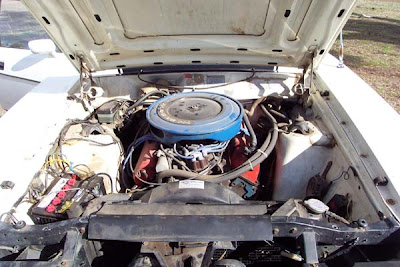
The tag contained stampings for the paint code, the last five digits of the VIN, and the options.

In this instance we can see code ‘9’ for Snow White paint and ‘R/Pack’ is for the sports handling suspension.

However, the ‘G.T.’ stamp is interesting. As we know, Ford never produced an GT model in the XC range, but they did offer the buyer the option of speccing up their car to the equivalent of an old style GT, or purchasing the GXL, which was the ‘sport/luxury’ model in the XC range.
The ‘G.T.’ on the tag for the AMS refers to the XB GT style black paintouts on the bonnet and on the lower sills and wheel wells.
The tag was located on the passenger side of the support and is seen here between the radiator cap and the rubber bonnet bumper.

The tag contained stampings for the paint code, the last five digits of the VIN, and the options.

In this instance we can see code ‘9’ for Snow White paint and ‘R/Pack’ is for the sports handling suspension.

However, the ‘G.T.’ stamp is interesting. As we know, Ford never produced an GT model in the XC range, but they did offer the buyer the option of speccing up their car to the equivalent of an old style GT, or purchasing the GXL, which was the ‘sport/luxury’ model in the XC range.
The ‘G.T.’ on the tag for the AMS refers to the XB GT style black paintouts on the bonnet and on the lower sills and wheel wells.
Tuesday, May 06, 2008


Wednesday, October 03, 2007

Tuesday, September 25, 2007
XB-XC changes
Sure enough, as some late XBs got the XC rear wings, so some also ended up fitted with XC dashes and door trims.


Monday, September 24, 2007


Sunday, September 23, 2007

Saturday, September 22, 2007
More changeovers
But, of course, this is not the end of the story, because after the XB came the XC, and as well as changing much mechanically and giving the Falcon a facelift, the XC also had a completely new dash.


Sunday, September 16, 2007
Model changeovers 2

This is a fine example of an XB GS coupe which was built very late in the XB’s production run, and what do we find

Yes, it has XC style rear wings. The conclusion is that Ford, or whoever was contracted to supply the stampings, must have started production of the XC style wings and the supply of XA/XB style wings became exhausted too early so they used the new style wings that had been delivered to the factory.
The first documented XB hardtop with XC rear marker lights I have knowledge of is a July, 1975 GT, and the next is an October, 1975 John Goss Special. July, 1975 is very early, considering XC’s were introduced in July, 1976.
Saturday, September 15, 2007
Model changeovers
One of the more intriguing aspects of Australian Fords which I don’t believe happened with American cars was the early introduction of parts or panels into the last models of the preceding range. This seems most prevalent on the XA/XB/XC models and hopefully we can show some of these aspects below.

If you examine the photograph of this 1975 John Goss Special which was based on the XB model, and compare it with the following photograph.

You will see that the 1978 XC, above, has horizontal marker lights in the rear wing whereas the XB - and the XA that proceeded it - had vertical marker lights.
As the fitting of these involved a stamping of the panel, you can see that new dies must have been used for the rear wing on the XC model, which was introduced in July, 1976.
Friday, September 14, 2007
XC Falcon

The XC was a further re-style of the third generation Falcon. The refined look was achieved by reducing the slope of the grille and introducing large rectangular headlamps on some models. The bonnet line was softened and more substantial bumpers fitted. The coke bottle effect was reduced by altering the style line running through the rear doors. The hardtop still struggled to sell, and Ford introduced the limited edition Cobra as the last of the two door version, and, as a sign of the times, there never was a GT version of the XC. Mid way through the life of the XC, Ford made some radical improvements to the car’s suspension to allow for radial tyres, and these models tend to be known as the ‘XC and a half’. The later XCs are easily identified by the introduction of the the classic Ford oval badge on the centre of the grille, its first use on an Australian Ford.
The XC was manufactured between July, 1976 and March, 1979. 171,082 were produced.
Friday, July 27, 2007
XC Tail lights

The XC sedan featured a modification of the XB style, splitting the lens horizontally with a chrome bar to fit in with the trim and fitting white reversing lights. Previously, Australian Fords used the rather unusual system of lighting both side indicator lamps for reversing lamps.

Whereas the hardtop remained the same as the XB, but painted black on some models.
Tuesday, July 24, 2007
Tail lamps

To accomodate the changes in the styling of the cars, and to conform to new lighting regulations, the tail lamps of the XA, XB and XC altered through the years also.
Monday, July 23, 2007
XC Door handles

XC coupe door handles - similar to those on the XB, but occasionally painted black.

And chromed in others.
Friday, July 20, 2007
Door handles
Another subtle difference between XA, XBs and XCs were the door handles.
The XA door handles were separate from the housing in that the housing was a stamped recess in the door skin, whereas on the XB and XC, the housing was an integral part of the handle assembly which fitted into a rectangular hole in the door. XC handles were similar, but in some models either the housing, or the whole assembly was painted black.
Also, the XB and XC handles themselves were ribbed.

XA sedan door handle style.

XA hardtop door handle style.
Monday, June 25, 2007

Subscribe to:
Posts (Atom)