Showing posts with label Falcon. Show all posts

Wednesday, September 12, 2007

XB Falcon


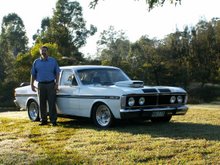
The XB featured a slight restyle of the previous model, featuring a cleaner but more aggressive front end with a forward sloping bonnet and a wide set, ‘egg-crate’ split grille. The design was very reminiscent of the 1971-73 U.S. Mustang. The tail lamps were also neatened. Many mechanical enhancements were made including the introduction of optional four wheel disk brakes, and the fitting of locally manufactured 302ci (4.9litre) and 351ci (5.8litre) Cleveland V8s. The hardtop continued to be offered, but sales were disappointing while the XB as a whole was the most popular Falcon yet.

The XB was manufactured between September, 1973 and July, 1976. 211,971 were produced.

Tuesday, September 11, 2007

XA Falcon


The XA model was the first completely designed and built in Australia. By the time it was released, the U.S. version had been discontinued some 18 months earlier, and the designers had the opportunity of styling a more ‘Australianised’ car. The result was a swoopy, coke bottle design, sleek but featuring a bigger, more roomy body and available with a wider choice of engines and a longer list of options. And, after a break of seven years, Ford introduced a two door hardtop version based on the sedan but with a lower roofline and wider rear wings. Marketed under the ‘Born on the Wind’ slogan, the XA was a great success for Ford of Australia and a confident statement of its independence.

The XA was manufactured between March, 1972 and September, 1973. 129,473 were produced.

Monday, July 16, 2007

XY Falcon

The XY marked the apogee of the second generation Falcons, superior in performance to its competitors, better built, fitted with a range of locally designed six cylinder engines, and in GT form, producing the ultimate and fastest Falcon of them all. Popular with police forces, rental companies and the public at large, the XY featured a new plastic grille split in the centre and revised tail lamps. Improvements were made to the seating, safety equipment and steps were taken to provide a smoother, quieter ride. The available 351ci (5.7litre) engine, while similar in capacity to that fitted to the previous model, was a completely new engine design, more modern and efficient, and when locally produced, would power the Falcon through the next decade.

The XY was manufactured between October, 1970 and March, 1972. 100,474 were produced.

Sunday, July 15, 2007

XW Falcon

The XW represented the first real attempt to more definitely differentiate the Australian Falcon from the styling of its U.S. equivalent. The basic structure remained the same, but the Australian car replaced the traditional round tail lamps once and for all with modern, horizontally split lenses, and introduced a heavier grille, with wrap around indicators and side lights, producing a distinctive and now unique design. Mechanical changes were also made, the most important and impressive being the fitting of the 351ci (5.7litre) V8 engine in various versions, a full 49ci larger than the biggest engine fitted to the U.S. version. The Australian Falcon had finally come of age.


The XW was manufactured between July, 1969 and October, 1970. 99,953 were produced.

XT Falcon

The XT Falcon was a mild restyle of the previous model, with a barely altered grille, but distinctive new tail lamps, circular lamps still, but cut by large rectangular indicator lenses. The V8 engine increased in size to the 302ci (4.9litre) version and there were minor mechanical revisions as Ford placed its Falcon squarely up against it competitors in the marketplace. They were greatly assisted in this with the XTs success in the London-Sydney Marathon rally, where its three entered cars took third, sixth and eighth places, capturing the Team Prize in the process.
The XT was manufactured between April, 1968 and July, 1969. 74,394 were produced.

Saturday, July 14, 2007

XR Falcon

Whereas the previous four ranges of Falcon tended to follow styling trends set by their full size US parent cars, and were marketed with reference to the ‘Thunderbird’, it was decided with the new XR range, which again followed a US design, to capitalise on the phenomenal success of the Mustang. The styling of the car was inspired by the Mustang, copying the coke bottle style line, and the long bonnet and short boot cue, but retaining the traditional round tail lamps. The result was a car that was modern and handsome and while the two door hardtop model disappeared, this was more than compensated for by the arrival, for the first time in the Australian Falcon, of the 289ci (4.7litre) V8 and some serious horsepower.
The XR was manufactured between September, 1966 and April, 1968. 87270 were produced.

Friday, June 29, 2007

XP Falcon

The XP was the last facelift of the original Falcon and featured an aggressive, squared off look to the front end and more solid styling overall. The development of the car over the years since its introduction paid off, and the XP was very well regarded by the press of the time, now more than capable of matching its competitors and winning ‘Wheels’ magazines Car of the Year award for 1965. Also introduced with the XP was the first Fairmont, the prestige model in the Falcon range, fitted out with all the latest luxury features.


The XP was manufactured between March, 1965 and September, 1966. 70,998 were produced.

Thursday, June 28, 2007

XM Falcon

The XM was another styling facelift of the original XK, with a much heavier and impressive front grille and, in a major break from being a derivative of the contemporary U.S. model, tail lamps raised to boot level height for greater visibility. As an indication of things to come, some ‘sportiness’ was introduced with a dummy air scoop on the bonnet, the introduction of a two door hardtop and the greater availability of the 121hp, 200ci (3.3litre) Super Pursuit engine. And finally, the front suspension troubles were cured completely with the use of strengthened components.


The XM was manufactured between February, 1964 and March, 1965. 47,039 were produced.

Wednesday, June 27, 2007

XL Falcon

The XL was introduced with some new styling changes, most notably to the grille, altering from a concave to a convex shape with recessed headlights and bumper mounted indicators. The tail lamps were revised and the rear roof line was changed to reflect Ford’s Thunderbird style theme. The most serious changes were made underneath with significant mechanical upgrades - a new gearbox, clutch, starter, air and oil filters - and an attempt to sort the weak front suspension without complete success.


The XL was manufactured between August, 1962 and February, 1964. 75,765 were produced.

Tuesday, June 26, 2007

XK Falcon

The XK was the first Falcon released, and was based very much on the equivalent U.S. Falcon, copying its styling almost without change. While fitted with robust mechanicals - a 144ci (2.4 litre) six cylinder engine and choice of three speed manual or two speed automatic - the U.S. designed suspension, especially at the front, was found to be fragile on Australia’s rougher roads, and warranty claims were so costly for Ford that there were rumours that production would be discontinued. But with the support of the U.S. parent company, the car survived.


The XK was manufactured between September, 1960 and August, 1962. 68,456 were produced.

Wednesday, June 20, 2007

When is a GS a GS?

When the original sale receipt tells you it is one. If you suspect that your car is a GS but has no actual GS badges on it there is nothing on the car’s data plate that will tell you that it is a GS, unlike a GT. One giveaway is to check the wiring under the dash as genuine GS cars had the GT wiring loom to allow fitment of the GT dash and its extra instruments. If your car has the extra gauges, but a cut and shut loom, you would suspect it was not original. Unfortunately, the Ford Motor Company of Australia is not, at this time, answering queries about suspected GS cars as it is doing for GTs.

Sunday, June 03, 2007

XY GS

Once again the GS Rally Pack was available on the XY model. In addition to being available on the Falcon 500, Futura and Fairmont sedans, it was also now an option on the Falcon 500 and Fairmont wagon also.

The actual GS options remained the same including the GT dash featuring speedometer, tachometer, odometer, oil pressure, water temperature and fuel gauges, but some other items crept onto the general option list, most notably a sunroof and a stereo radio/tape player. For performance enthusiasts, the most important option was now a 250hp two barrel carburettor equipped Cleveland version of the 351ci V8. It may not have rivalled the 290hp GT, but it really wasn’t too far off now.


This is a lovely XY GS in Onyx Black showing the GS stripe terminating in the GS badge and the chromed XR/XT GT lookalike wheel covers


Here are close ups of the stylised GS badge and of the wheel cover.

Saturday, June 02, 2007

XW GS

Available on the Falcon 500, Futura and Fairmont sedan, the GS added the following features; GS Rally stripes that ran from the front indicators to the middle of the rear wing and ended with the GS insignia and full wheel covers that were the same as the stainless steel wheel covers used on the XR and XT GT models. Inside, a three spoke, deep dished wooden rimmed steering wheel with rim squeeze horn and full dash instrumentation were the same as on the GT model.

From there the buyer could then run riot through the normal options list adding; bucket seats and sports console with four speed or T-Bar automatic, a 302ci 220hp V8, power disk brakes, air conditioning, tinted windscreen, vinyl roof; anything, in fact, that was available in the catalogue. Ford advertised the GS as - ‘Make up your own Grand Sport’ - and, while the car did not have the appeal of the GT, it did offer the cost conscious a distinctive alternative.


Friday, May 25, 2007

Compliance plates 5

This 12-71 XY Fairmont has ‘SED’ on the plate.


As does this 12-71 Falcon 500.

Wednesday, May 23, 2007

Compliance plates 4

Here, for comparison, is a plate for a ‘FALCON GT’ of the XY model range. Being only four door cars ‘SED(an)’ would appear to be implied.


Or, you could describe it as a ‘FALCON G.T’

Monday, February 26, 2007

EL Faclon 1996-8


The last of the E-Series Falcons - the EL - was released in October 1996 and was faced with the tough job of fending off the upcoming Holden VT Commodore until the all-new AU Falcon was ready.
This time around, the GLi and Futura got their grilles back.
The new grille, which was not to everyone’s taste, was an oval shape, in keeping with Ford’s then global design theme (think Taurus, Mondeo). There were new headlights, bonnet and front bumper. Fairmont models featured new chrome grilles and the XR models' quad-headlights were slightly changed. At the back, the Fairmonts gained a new number plate surround in between the unchanged tail lights, while all other models now had amber indicators. Wagon indicators were now white. Completing the visual changes were new badges and new ugly wheel designs for every model.
The suspension on the EL Falcon was a giant leap forward from the EF. It was developed by a Tickford engineer, and a balance was achieved between sharper handling and a quiet soft ride. Alterations to angles, settings and dampers also gave the Falcon better straight line stability and a softer impact over bumps. Falcon’s front and rear suspension set-ups were now working in harmony.Improvements were made to the steering and the Fairmont Ghia now featured speed-sensitive power steering which meant less effort at parking speeds without affecting steering feel at higher speeds.
Changes to get rid of interior noise made the EL even more quiet.Safety wasn’t forgotten, with the EL picking up the latest generation Bosch 5.3 anti-lock braking, still optional on the GLi. The windscreen and windows were protected by Smart Tint, offering the same protection as SPF15 sunscreen. Smart Tint also resulted in much lower temperatures inside the cabin.Inside, the car was freshened up even more. There were new colour schemes, and buttons and switches were colour-coordinated instead of being black. The front seat backs were reshaped, as were the front and rear head restraints, while lumbar adjustment was improved and the seats were trimmed in lighter and more airy fabrics.
Other changes included mobile phone wiring and for the wagons, an optional cargo barrier and optional third-row front-facing kids seat.

Sunday, February 25, 2007

EF Falcon 1994-6


Ford’s next evolution of the EA Falcon was so different, it could almost be regarded as a totally new model. On the outside, the doors were the only parts carried over.The EF’s styling was softer and rounder and this made the car appear smaller than it actually was.
GLi and Futura models no longer had a grille between the head lights - only the blue oval badge. However, Fairmont and Fairmont Ghia featured slightly different headlights, a fake grille and the Fairlane/LTD bonnet. The XR models kept their trademark quad-headlight design. Every model had body coloured door handles, while alloy wheels and a Tickford body kit were optional.
At the rear, all sedans had semi-circle shaped tail lights with clear indicators. Fairmont models featured a chrome “appliqué” above the number plate. The rear end of the Falcon wagon was carried over from the ED.An all new interior resulted in a light, airy feeling. Cup holders were standard on every model and for the first time, the Falcon’s awkward umbrella handbrake became history, replaced by a conventional floor-mounted design. The very first cars had fuel filler and boot release buttons which were often accidentally pressed when inserting the ignition key. These buttons were recessed a short time later.
Ford paid a lot of attention to safety, most evident by the standard driver’s airbag on all models, a first for an Australian car. Anti-submarining pans were installed to prevent front passengers from slipping out under the seat belt, and the body was reinforced for extra rollover strength and front impact protection. Ford developed the Smart Bar, a bull bar specially designed to work with the driver’s airbag. This innovation was a world first.
Falcon’s big six now had an improved management computer - the EEC V. This worked in conjunction with Computer Torque Control (CTC), which noticeably boosted power and torque to 157kW at 4900rpm and 357Nm at 3000rpm. New internals were added as well as a dual intake system and hydraulic engine mounts. All of these changes resulted in a drop in fuel consumption and extra refinement.
There were a few problems with the EF’s handling. The car’s rear end was twitchy and nervous and when driven into a corner, the rear end wouldn’t follow with the same precision.
This trait was unsettling and it undermined driver confidence, however the problem wasn’t as bad when the EF was driven within its limits. Not all EF Falcons were affected to the same extent.
October 1995 saw the EF Series II facelift. The big news was the new passenger airbag. It was a special design because it protected not only the front passenger, but also the middle passenger (sitting in a GLi with the optional bench seat). The passenger airbag was a $510 option, standard on Fairmont Ghia. The Fairmont Ghia benefited the most from this upgrade, and it was now aimed at the executive who loves to drive. It featured the XR6 engine, lowered suspension and uprated front springs, leather trim and extra chrome - in and out.The rest of the range featured a retuned suspension, different front seat padding to lower the ride height and 25mm extra rearward seat movement.Wind and road noise were isolated from the cabin by using neoprene rubber-based blockers. The XR6 wagon was dropped.

Saturday, February 24, 2007

ED Falcon 1993-4


The only reason the ED Falcon was released in August 1993 was to battle the best selling Commodore. The EF facelift was still a year off and Ford didn’t want to lose ground to Holden’s new VR. Visual changes were a new grille, and the XR models gained new quad round headlights.
XR models also had red inserts in the bumper and the body mouldings, and a new XR model was released - the XR8 Sprint. The Sprint didn’t stand out from the crowd, instead relying on it’s performance. The Sprint’s engine was almost identical to the EB GT’s V8 and had 195kW and 405Nm. There were different wheels and black inserts (instead of red), and only 300 Sprints were built.The Futura name made a comeback with the ED and was aimed at private buyers to compete with Holden’s Commodore Acclaim. It came with ABS brakes, cruise control, full instrumentation and an 8 speaker sound system. On the outside, the Futura had different wheel trims and body-coloured mirrors.The Fairmont Ghia wagon was dropped.

Thursday, February 22, 2007

EB Falcon 1991-3


There were big changes for the EB Falcon, although these were not visual. The main differences on the outside were the placement of the Ford badge - now in the grille, new wheel trims andreverse lights on either side of the number plate. Quality was greatly improved over the EA.The biggest news was the return of the V8. The 5L V8 was brought back to life with fuel injection and was available on all models. The other engines were the same as the EA range.
Improvements to the suspension consisted of gas-pressurised shock absorbers, uprated mounting bushes, revised front geometry and higher geared steering, making the car much more refined.
Series II, almost a different model, arrived in April 1992 and, on the base model, brought body-coloured bumpers, glossy black door handles and GLi badges.The new engine in Series II was a quieter, greatly improved 4L multi-point six cylinder, and it replaced both 3.9L units. Safety was the order of the day, with the EB II gaining foam-filled extra-strength roof pillars, a stronger roof, new seat belt lockers and optional ABS braking. In early 1993, a lap sash rear seat belt became standard - a first for an Australian car.
Tickford Vehicle Engineering was established, a joint venture with Ford Australia, and one of the first models to come from this operation was the hot new S XR6. Released in October 1992, Tickford improvement gave the 4 litre enough performance to match a V8. A month later a new GT Falcon was unveiled to celebrate 25 years.
By the end of 1992, all Falcons got the new Smartlock security system with Tibbe locks and an immobiliser. South Australian police invited four professional car thieves to steal the EB. After four days, they gave up.
In 1993 a Tickford factory LPG option became available.

Wednesday, February 21, 2007

EA FAlcon 1988-91


When it came time to design the all new EA Falcon, Ford Australia again looked at overseas models. The European Granada/Scorpio and American Taurus were brought to Australia. The two cars had significantly less shoulder room and the Taurus was front wheel drive.
So Ford decided to build the EA from the ground up.
Early EA prototypes resembled the Scorpio, but the car evolved into the EA we know. The computer aided design prototype was shipped to fashion conscious West Germany, to gauge people’s reactions. If the style won the hearts of the West Germans, it would quickly gain approval here. The EA was displayed with the best of them: a BMW 5 series, an Audi 100 and a Mercedes Benz 190. It was a hit with the Germans, so Ford knew it had the styling right.
The all new Falcon was launched in March 1988 to beat Holden’s bigger VN Commodore. It captured the interest of buyers and the press, and the launch was amazingly successful. But tales began to leak out of Broadmeadows about quality problems. The new hi-tech robot welder had some teething problems, some examples included a brake pedal that stayed on the floor; a metal panel holding the door mountings flexing, causing the doors to shake; and a faulty computer chip, causing trouble in the engine management system. But what the public didn’t know was that most of these problems were discovered and rectified before launch, either in the plant, or by the dealer before the car wound up in the showroom. These troubles should not have occurred, part of the reason they did was because Ford was also working hard on its new Capri.
Other early problems were the front suspension and poor paint. Ford buyers were told there were difficulties and their car would take a little longer, and this approach worked. There were record sales, despite all the bad publicity.
The sleek new Falcon had three six cylinder engines: a 3.2L, 3.9L and 3.9L multi-point. All engines had fuel injection (the 3.2 and 3.9 had the basic single-point system) and they were all overhead cam engines. The 3.9 could out-perform the old 351V8, the 3.2 could not and was dropped in December 1988. Fuel economy was good but unfortunately the Falcon was stuck with a three speed auto, or the standard 5 speed manual.
Front suspension was all new and designed to match that of the state of the art Hondas. The Watts link rear suspension was retained, despite criticism that it should have been independent rear suspension. Power rack and pinion steering was introduced and this brought a much tighter turning circle.
The sleek styling proved very popular, but it wasn’t all looks. It was aerodynamic as well, being the first Falcon to make use of wind tunnel testing.
The EA range was simplified to a sedan and wagon. Even so, a ute and van were still available, they were just the old XF design. (In 1989, XF utes were also being sold as Nissans. As part of the deal, Nissan Patrols were sold as Ford Mavericks). Inside the EA, a decent driving position could be had, as the steering was adjustable. Interior space was increased; the umbrella handbrake lived on.In October 1989, the introduction of the long-awaited four speed auto marked the Series II. Changes included a body-coloured B-pillar, firmer suspension and small interior changes.
To celebrate its 30th anniversary, a special model was released. Based on the GL, it featured new side badges and Ford’s new security system - Tibbe locks with central locking. The Fairmont now got more equipment.