Showing posts with label D Block. Show all posts

Monday, April 30, 2007

Rocker covers 3

There is another subtle external difference to the rocker covers as fitted to ‘D’ blocks, and U.S. and Australian ‘square’ blocks.


The ‘first’ type, dimpled cover has the ‘Power by Ford’ logo enclosed in a ribbed box which has larger rounded corners as shown above.

Whereas the ‘second’, chamfered cover has a much tighter, almost square corner to the surrounding ribbed box.

Sunday, April 29, 2007

Rocker Covers 2

The ‘second’ style rocker cover was introduced with the ‘square’ block and it has a much more pronounced chamfer to the front corner.


While it is generally accepted as a rule of thumb that it was only the ‘square blocks that had this cover, there is some evidence to show that a few ‘D’ blocks also were fitted with these ‘second’ type rocker covers.

When Australian manufacture of the 351C started, this was the rocker cover that they initially produced.

Saturday, April 28, 2007

Rocker Covers


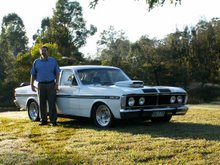
This is an original XY GT with a ‘D’ block and the ‘first’ style rocker covers with the small dimple in the closest corner of the cover. These rocker covers were supplied on all of the imported ‘D’ block 351C’s, whether they were 4V or 2V.


A 351C 2V from the ZD fairlane brochure.

Wednesday, April 25, 2007

Cleveland engines part 13

There are, of course, some strange anomalies.


This is a July,1972 XA GT.


It has a ‘D’ block and ‘4’ heads. A leftover from the XY perhaps.
Here is another, showing an original factory rocker cover sticker in place.

Monday, April 23, 2007

Cleveland engines part 12

And here are the features we have discused so far:- CK608, ‘D’ block and ‘4’ cylinder heads.


Here is an XA GT.


CK617, ‘square’ block and ‘4dot’.

Saturday, April 21, 2007

Cleveland cylinder heads

To fit 351C engines, it is generally accepted that there are seven types of production Cleveland heads that you may come across, five U.S. and two Australian.

They are:-
U.S. 4V Closed chamber with a ‘4’ cast in the corner
U.S. 4V Open chamber with a ‘4’ cast in the corner
U.S. 4V Closed chamber with a ‘4’ and a ‘dot’ cast in the corner
U.S. 2V Open chamber with a ‘2’ cast in the corner
U.S. 2V Open chamber with a ‘2’ and a ‘dot’ cast in the corner
Aus 2V Open chamber with nothing cast in the corner as fitted to Aus 351C
Aus 2V Closed chamber with nothing cast in the corner as fitted to Aus 302C

To take them in turn.

The U.S. 4V closed chamber head with the ‘4’ casting is the head fitted to the CK608 and CK609 engines installed in XW and XY GT’s. These heads were fitted to imported ‘D’ block engines.

The U.S. 4V open chamber head was not fitted to any Australian Ford.

The U.S. 4V closed chamber head with the ‘4’ and ‘dot’ casting is the head fitted to the CK617 engines installed from mid 1972 XA through to end of 1973 XB manual transmission equipped GT’s. It has a slightly larger chamber than the ‘4’ only casting with a resultant half a point compression drop in C.R. These engines were imported ‘square’ block engines.

The U.S. 2V open chamber head with the ‘2’ casting is the head used on the CK601 and CK604 engines in XY’s and ZD’s. These were imported ‘D’ block engines.

The U.S. 2V open chamber heads with the ‘2’ and ‘dot’ casting in the head were used on the CK614 engines fitted to late XY’s and ZD’s. These engines were imported ‘square’ block engines.

The Aus 2V open chamber head with no casting mark is the head fitted to Australian built 351C’s fitted to XA’s through to XE’s with both four barrel and two barrel carbs.

The Aus 2V closed chamber head with no casting mark is the head fitted to Australian built 302C’s fitted to XA’s to XE’s with two barrel and four barrel carbs. It has the smallest chamber size of any of the production Cleveland heads.

Thursday, April 19, 2007

‘D’ block or the ‘square’ block


The terms ‘D’ block and ‘square’ block apply to differences in the casting of the engine block. The ‘D’ block is the earlier casting, in fact the initial casting of the 351C block and the ‘square’ block is the later one. How much later is open to conjecture. ‘Square’ blocks would appear to have been available in the U.S. in 1971, and there is some evidence to show that the ‘square’ block appeared in automatic XY 351C 2V’s as early as May, 1971, and in manual XY 351C 2V’s in December, 1971. It does appear that XY 351C 4V engines continued with ‘D’ blocks. What can be said though is that no XW or XY GT came with a square block, and that all Australian built engines are patterned after the ‘square’ blocks.

The ‘D’


The ‘D’ can be seen on the cast extension on the front of the block, adjacent to the petrol pipe.


Compare with the later square block.


Monday, April 16, 2007

Cleveland engines part 7

Originally in the U.S. this number was on a metal tag that was attached to an ancilliary bracket or more usually sandwiched under the coil mounting bracket, but later in life they were reduced to a white paper sticker on the front of the right hand valve cover. For some reason, which is still a bit of a mystery, the 351C’s built in the U.S. and shipped for export acquired the letter ‘C’ in front of the ‘K’ and became CK601, CK604, CK608, CK609, CK614, CK616 and CK617, and this is what appeared on the paper tag on engines fitted in Australia. There is a some credence to the thought that the ‘C’ stood for ‘Canada’ as they initially received non-emission export engines, and for simplicity, the ‘CK’ then applied to all export engines. It is also worth mentioning that in the US the switch from using a metal tag to a paper decal took place in February, 1973, yet the paper decals were appearing on Australian engines before that.
Here is an example of a coil tag that was fitted to an XA GT RPO83.


What is interesting about this tag is that XA GT RPO’s were built in August, 1973. The tag decodes as - ‘351C’, the engine; ‘72’, the model year; ‘5’, the change level or version; ‘G26’, 26th of July assembly date; and ‘CK617J1’, the engine code. On U.S. tags there is usually a digit in front of the ‘G26’ which signifies the year of production. The year is missing on this Australian or export tag which may have been a a deliberate policy to allow Ford to stockpile export engines, either in the U.S. or at their destination.
It is also worth mentioning that the equivalent paper tag for this engine reads ‘CK617J1-W’ and it signifies a special order, manual transmission only square block import engine with big port heads. Some more of what this means is explained below.
Here is an example of the paper tag for a ‘CK608’ engine, showing its location.

As these paper tags appear in several of the pictures I'll use over the next few days, here is a breakdown of their significance:
CK608 A1 70-1 - manual D block 4 heads (XW-XA)
CK609 A1 70-1 - auto D block 4 heads (XW-XA)
CK616 J1 71-3 - auto D block 4 dot heads
CK616 J3 72-5 - auto D block 4 dot heads (1971 casting
CK616 J3 72-5 - auto square block 4 dot heads (1972 casting)
CK617 J1 71-1 - manual D block 4 dot heads
CK617 J1 72-5 - manual square block 4 dot heads
CK617 J1W 72-5 - manual square block 4 dot heads