Showing posts with label Phase 3. Show all posts

Monday, December 03, 2007

Spoilers


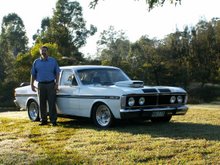
By way of comparison, here is a genuine Phase3 fitted with the factory spoiler. Note that the feet are different, and the means of adjusting the angle of the spoiler.

Note that when the spoiler was used on Phase3 race cars at Bathurst, and also on later XB hardtops at Bathurst, the wing was cranked over to almost turn from being an aerofoil parallel to the ground to a genuine spoiler as we would think of one these days. It is worth noting that in the U.S. 1970 TransAm racing series, the Boss302 Mustangs used the same aerofoil cranked over to replicate a spoiler.

Wednesday, July 04, 2007

XY GT shaker

Yesterday I mentioned that the engine used the snorkel intake until the throttle was opened. This was the case with the ‘normal’ XY GT.

With the GTHO Phase3’s, things were slightly different.


Ford removed the snorkel and fitted a blanking panel, and let the 780cfm Holley carburettor take its air continuously through the Shaker.

As an aside, note the sticker on the front of the rocker cover reading ‘CK608A1’. This has some significance as it shows that the engine is a U.S. imported Cleveland engine as fitted to XW and XYs. The ‘K608’ signifies that is is a 4V engine - an M-code in U.S. VIN parlance - and ‘A1’ signifies that is is, A - First design level, and 1 - First revision. The ‘C’ prefix is unusual and doesn’t show up anywhere in Ford U.S. literature but is generally accepted to mean export.

To further digress, ‘CK617’ was the engine code for imported Clevelands fitted to XA and XB GTs. Very early on, all XAs, automatic and manual had imported ‘CK617’ engines, but the automatic cars quickly converted to Australian built 2V-style engines. Manual cars through XA were fitted with U.S. 4V engines, and some early manual XB GTs had ‘CK617’ engines also, before all XB GTs used Australian built 2V-style engines.

Friday, May 18, 2007

Carbs continued

The Phase cars - XW Phase2 and XY Phase3 - were fitted with four barrel Holley carbs as seen here.


Thursday, May 03, 2007

Air cleaners 2

XY GT and GTHO’s had the shaker air cleaner fitted to their 351C’s.


GTHO’s did not have a snorkel.


Note the support bracket and nut for the air cleaner.


And as fitted to non-HO XY GT’s, the air cleaner had a snorkel. This shape of snorkel, with the belled end, is correct for XY Falcons.

Monday, April 23, 2007

Cleveland cylinder heads 2

And so to put some of this in context.


Here is an XY GTHO.

Saturday, April 14, 2007

Cleveland engines continued

In the U.S. for the very brief period that the musclecar/horsepower craze continued during the 351C’s early life, the 4V spawned a small clutch of developments:- the 1971 Boss 351; the 351CobraJets, or CJs; and four bolt mains caps. These were U.S. only developments and never made it to the Australian chapter of the 351C story to which we now turn.
The first 351C engines to appear in an Australian Ford were those fitted to the XW GT Phase 1.5s built in February, 1970. The U.S. 351C was announced for the 1970 model year and introduced in September, 1969, so it took less than six months for the Cleveland to appear in Australia. The Phase 1.5 - one and a half - was to all intents and purposes an XW GTHO with all the running gear from the 351 Windsor powered Phase1 but with an imported 351C 4V engines fitted. They were cars to tide the market over until the full production Cleveland powered XW GTs were released in April, 1970. The regular production XWGT, powered by the 351C, then ran out the XW model to October, 1970. Later, introduced in June, 1970, was the XW GTHO Phase2 fitted with the U.S. imported 351C engine which had a solid lifter camshaft, and a 750cfm Holley carburettor. You can see that the 351C was regarded first and foremost as its flagship engine.
With the October, 1970 introduction of the XY Falcon and ZD Fairmont range of cars, the Cleveland progressed beyond its performance image and 250hp, two barrel carburetored, 2V versions were offered as the top option on both models. The 300hp, four barrelled, 4V version of the engine was only offered on the XY GT and GTHO. Both these engines were still imported, but Ford Australia was keen to build its own and had tooled up to provide locally manfactured 351C and 302C engines. Why tool for a 302C engine when they had been using the 302W ? Well, it provided economies of scale, being able to use all of the ancilliary parts from one engine on another, and all for the sake of a different crank and rods.
And so the March, 1972 introduction of the Australian designed XA Falcon range also saw the debut of Australian built 351C and 302C in two barrel carbed, 2V form. There have been some reports that 302C’s were fitted to Brisbane built, December, 1971 XY Falcons. Brisbane cars have the letter ‘H’ as the second leter of their VIN. For the moment, the four barrel, 4V engines were imported, but by the early/middle of 1973 Ford Australia had developed their own four barrel fed 351C but used their own 2V style heads on the engine.
This is where the 2V and 4V descriptive terms become somewhat entwined. The distinct separation that applied in the U.S. between 2V and 4V ensured that a 2V Cleveland had a two barrel carb and inlet manifold, small inlet and exhaust ports and an enlarged chamber volume, while the 4V Cleveland had a four barrel carb, large inlet and exhaust ports and reduced size chamber volume which created a higher compression ratio. Now the Australians introduced a 2V head that took either a two or a four barrel carb inlet manifold, and had a large, but not as large as the U.S. 2V, open chamber size, plus, for further confusion, they introduced a 302C engine that had 2V heads which had a two barrel carb but a chamber volume smaller than anything the U.S. had offered, even on their highest performance Clevelands.

Tuesday, March 13, 2007

XA GT - The Phase IV & the Supercar Scare


The "Supercar Scare" – a journalistic beat-up of hi-performance production cars from all of the big three car manufacturers – not only caused the demise of the GTHO as a production model, but was also responsible for a change in the regulations for Touring Car racing. The XA GTHO Phase IV, was to be the ultimate road and race car to be built by Ford in Australia. Unfortunately, just as production was about to start, a number of well-known motoring journalists started a smear campaign against the next generation of “specials” being developed by the three major manufacturers – the Phase IV Falcon GTHO, the XU-2 Torana V8 and the E55 Charger V8. In their articles, these journalists claimed that each of the vehicles being developed could top 160 MPH in road trim and in doing so would represent a significant danger to the Australian motoring population by causing death and mayhem on public roads. Essentially... "bullets on wheels"!!!
But in true journalistic fashion, the old adage of “never let the truth get in the way of a good story” was well in force. By concentrating only on guesstimates of the top speed potential of the cars (the road going Phase IV's top speed was actually only around 150 MPH), the question of primary safety was generally overlooked. Although able to travel very quickly in a straight line, these cars were also designed for safety, with the handling, braking, steering and road-holding commensurate with the speed potential of the vehicle. If the truth be told, the greatest danger on the Australian roads at the time was the typical family sedan with drum brakes, cross-ply tyres and built in under-steer – unsafe at any speed in my opinion.
In the end, the journalists whipped up sufficient negative public opinion, that the Government of the day decided that these cars should not be made available to the public, even threatening the manufactures with the cancellation of fleet contracts, should the vehicles be built. Due to the obvious financial ramifications involved, the manufacturers had no choice and cancelled production.
The XA GTHO/PHASE IV
So how special was the Phase IV going to be? Externally, they would have been no different from the standard XAGT four door. That’s right, all Phase IVs were to have been four door sedans. The only giveaway, would have been the special Bathurst Globe mags, which although designed for the Phase IV, eventually found there way on to the Phase IIIs. Apart from looking good, these mags provided a number of benefits. These wheels were stronger than the steel versions, they vastly reduced unsprung weight – which helps with steering and handling – and they also cut brake operating temperatures down from 840˚C to 450˚C. Mechanically however, the Phase IV was very similar to the Phase III. The brakes were the same, with the front disc and rear finned drum setup being carried over, as was the 36 gallon fuel tank. Although the front springs remained the same as the Phase III, the wider track of the XA model and new wheels had the side effect of softening the spring rating for a better ride. A newly developed rear spring setup provided greater roll stiffness, allowing the rear bar to be removed. Combined with a slightly softer front sway bar, the Phase IV was far more neutral in its roadholding.
In the engine department, a number of changes were made. Most significant were the revisions to the cylinder heads, where larger valves and changes to the shape of the combustion chambers helped improve volumetric efficiency. Although these changes reduced the compression ratio slightly, they helped improve torque and more importantly, allowed it to come in a full 1000 RPMs lower in the rev range. This made the engine much more tractable and as a side benefit, more fuel efficient. The “Buddy-Bar”aluminium inlet manifold – that was available through Ford as a performance upgrade – were also being considered, but never actually made it into production. Changes to the exhaust system also helped improve the spread of torque over a greater rev range, while a new radiator fan – which incorporated blades that flatten at high RPMs – helped minimise horsepower losses. While the camshaft and carburettor remained the same, the bigger radiator from air-conditioned Falcons was used to provide greater cooling.
As with the Phase III, a rev limiter was also incorporated, but unlike the bulky module bolted to the firewall in the Phase III, the Phase IV had its rev limiter built into the rotor button of the Bosch twin-point distributor. When the engine was revved to the 6200 RPM limit, centrifugal force would cause a small weight to form a contact within the rotor button. The resultant short circuit would disrupt the spark being fed to the plugs and limit the engine from revving further. Porche used the same system in their cars.
To help the problem of oil surge, encounted during high speed cornering, “ears” were welded to the sides of the sumps, to not only increase the capacity from eight to eleven pints, but also to help concentrate the volume of oil around the oil pump pickup. Due to the improved torque characteristics of the engine, the “detroit locker” diff incorporated a taller ratio of 3.00:1 (as against 3.25:1 for the standard Phase III) and was driven through a standard wide ratio gearbox. This provided the Phase IV with a gearing of 24.4 MPH/1000 RPM in top, which converts to 151 MPH at the 6200 RPM limit.
Total production of Phase IVs was to be 200, with 100 to be built at the end of June 1972 with the remaining 100 at the end of July. As we all know, however, only four were actually built – one pre-production model (which is the only one actually plated as a GTHO) and three racing versions (one each for Allan Moffat and Fred Gibson and a spare). Of these however, only three survive – two of the racecars and the production model.
After full production of the Phase IV was cancelled, Ford decided to sell off the four cars. The spare car – which had the least race preparation – initially went to John Goss via McLeod Ford, who assembled the car for road use. In 1977 Fred Gibson test drove the car (then with only 1900 miles on the clock) for Racing Car News. Fred’s verdict was that it was a much better and more sophisticated car than the Phase III and would have developed into a great racecar.
The second racecar was delivered to Bruce Hodgson, who successfully rallied the car over a number of years, even though this type of motorsport was light years away from its intended purpose. Unfortunately a head on with a Commodore destroyed the car and although the wreck is believed to exist, the car is unlikely to re-appear. The first and most developed of the three race cars, was originally sold by Howard Marsden to Keith Goodall in Townsville and currently resides in the Bowden collection on the Sunshine Coast – this car being the one that is pictured in most of the magazine articles. The production model, is still believed to be owned by a dentist in Sydney who must have been the astute buyer, when offered for sale in 1978 at a car yard.

Sunday, March 11, 2007

XA GT - A New Direction


In December 1971, production of the all new ‘Australian’ designed XA range of Falcons commenced and in keeping with tradition, a GT was included in the model range. Changes from the previous model were dramatic, with totally new and much sleeker body work covering only a mildly revised floor pan and mechanicals. Externally and internally, the XAGT was completely different from its predecessors in the way it looked and felt. Gone was the blunt, hard-edged styling that was first introduced with the XR range, being replaced with a much softer and smoother aerodynamic package.
Whilst the new model maintained the 111 in. wheelbase of the XY, the new XAs included increases in overall length (1.9 in.), width (1.2 in.), front track (1.6 in.), rear track (1.5 in.) and weight (14 lbs.). The only dimensional decreases, were to the overall height (1.9 in.) and ground clearance (0.75 in.).
To help distinguish the XAGT from other models in the range, the designers added functional bonnet scoops, fake air intakes on the front guards, bonnet blackouts and a black accent line that ran along the sills, over the guards and around the back of the car to include the rear indicator assemblies. In standard form, the quarter window was also removed, however you could order your car with quarter vents, if you liked.
As with the exterior, the interior also came in for some dramatic changes. Initially noticeable was the new wrap around style dash, which gave the driver the impression of sitting in the cockpit of a plane. The instrument panel was dominated by the large 140 MPH speedo and 8000 RPM tacho, with ancillary gauges for fuel, oil pressure, water temperature and battery charge located above. The new seats were of a high-backed design, which gave greater support and provided a built-in headrest.
Mechanically, the XAGT was almost identical to the XYGT when it was introduced, using the same fully imported 351 4V cleveland engine, although the 302 and 351 2V Cleveland V8 engines being put into the lesser models, were now being locally manufactured. Gearbox and differential combinations also remained the same, as did the front disc/rear drum setup, although the XAs now incorporated the brake proportioning valve setup previously found on the Phase II & III GTHOs. In keeping with the changes to the appearance and to help take advantage of the wider track, the suspension settings were softened to give a ride that was both less harsh and quieter.
The standard 16 gallon fuel tank found in the XY range was increased to 17.5 gallons for the XA, with the 36 gallon unit still being an option for the XAGT only. Standard wheels for the XAGT returned to the ‘12 slot’ design previously found on the early XWGTs but now being manufactured by ROH here in Australia. Tyres were still the ER 70 x 14 HR size Dunlop SP Sport (Aquajets) radial ply tyres. As with the XY Ford also continued the “Sports Road Wheels” as an option.
While the overall performance figures for the new GT were much the same as it’s predecessor, with a top speed of (122-129 MPH) and quarter mile times (15.1-15.8 sec.) there was actually an improvement over the XYGT in the 0-100 MPH tests, with the XAGT recording times around a second quicker (18.7-19.2 sec). Testers of the day put this improvement down to the new slippery shape.
The XAGT – HARDTOP
If the public were impressed with the new four door version of the XAGT, the two door version really knocked their socks off. Not since the XM-XP Falcon range had Ford produced a two door Falcon, however with the success of the Monaro and Charger, Ford needed a competitor to gain needed sales.
Dimensionally, the two door was the same as the four door, except for three areas; height (2 in. lower), width (3 in. wider) and weight (15 lbs. heavier). The extra width came at the rear wheel arches, which were aching for a decent set of wide wheels and tyres. Following the demise of the Phase IV, this was obviously going to be the weapon of choice for all Ford drivers.
Cosmetically, there was little difference – apart from the obvious – between the two models, however the rear of the hardtop was sharply chopped and tail lights were of a recessed design. Production of the XAGTs commenced in December 1971 for the four door models and July 1972 for the two door models, with production for both ceasing in September 1973. Total production of XAGTs was 2759, with 891 of these being hardtops.

Friday, March 09, 2007

XW GT - The Super Roo


Following the sales success of both the XR and XT GTs, Ford Australia decided that the GT would continue in its upcoming model and in May 1969, production of the XW GT - flagship of the XW Falcon range - commenced. However the new GT was a far cry from the relatively subdued XT GT.
The new model was much bolder and meaner looking, with a new front and rear end treatment, a large range of striking colours, blackouts around the doors and on the bonnet, bonnet scoop, driving lights, chrome strips, badges on the guards and boot lid, a big wide stripe down each side and a decal of a V8 powered kangaroo burning rubber, described as the Super Roo. The new GT certainly made an impact and was not the type of car for those looking for anonymity.
Mechanically, the 302 cu.in. V8 in the XT GT was initially replaced by the larger and more powerful 351 cu.in. version of the Windsor motor. This increase in size, along with compression being raised from 10 to 1, to 10.7 to 1, increased engine power from 230 HP at 4800 rpm to 290 HP at 4800 rpm and torque from 310 lbs/ft at 3800 rpm to 385 lbs/ft at 3800 rpm. To handle the extra power and torque, the XW GT received the venerable Ford 9 inch limited slip diff, running 3.25:1 gears. As with the XT GT, automatic transmission was also available in the XW GT, however the stronger FMX auto replaced the C4 auto of the previous model.
With the growing importance of the Bathurst race, a number of other changes were made to improve the XW GTs race winning potential. These included stiffer suspension, 11.25 in. ventilated front disc brakes and an enormous 36 gallon fuel tank - obviously to minimise fuel stops in the great race. Wheels and tyres were also upgraded to 6.0 in. wide Kelsey Hayes riveted ‘12 slot’ rims running ER 70 x 14 HR Dunlop SP or Olympic ‘Wide Ride’ radial ply tyres.
Although these changes made the new GT a much more performance oriented vehicle than it’s predecessor, the XW GTs increased weight ensured that its top speed (125-130 MPH) and quarter mile times (15.5-16.0 sec.) were very similar to those of the XT GT. Only in the 0-100 MPH times (20.3-20.9 sec) did the XW GT show its potential, being around 3 sec. quicker than the XT GT.
It is generally accepted that Windsor powered XW GTs were produced up until the end of February 1970, with total production up to this point being 1268 vehicles. The exact change over date for the Cleveland engine is however unclear and some may have continued into March 1970. At a cost of only $4250 incl. tax, the new GT was considered by ‘Wheels’ magazine, to be “the best performance bargain in Australia”.
As good as the new model was, the factory wanted something better to race at Bathurst and so an even more potent version - the XW GTHO - was developed.
THE GTHO
Production of the XW GTHO - with HO standing for Handling Option (not High Output) - commenced in July 1969. Changes from the standard model included replacing the cast iron inlet manifold and Autolite 450 cfm carburettor with a Ford (Buddy Bar) aluminium inlet manifold and 600cfm Holley carburettor (similar to the one used on the 390 Mustang GT), a bigger cam, heavy duty alternator, a 3 in. tailshaft, bigger front sway bar and a rear sway bar. For marketing reasons, Ford still claimed only 290 bhp for the GTHO - the same as for the standard XW GT, even though it was obviously more powerful. So special was the GTHO, that Ford gave it a different model number (18939) compared to the standard GT (18938). Interestingly, this convention was not carried through to the Phase 3, with the XY GT and HO of that year, having the same model number. More about the vagaries of model numbers for a later issue.
Although top speed for the GTHO (130 MPH) was similar to the standard model, how it got there was a vast improvement over the GT. The quarter mile times (14.4-15.0 sec.) show a dramatic improvement over the GT, with the 0-100 MPH times (16.7-16.8 sec) confirming its acceleration capabilities.
Having produced a 1-2-3 victory at the Sandown 3 Hour race only weeks before, great things were expected of the GTHO at Bathurst, on that first weekend in October. Everything looked good in practice and qualifying. The Geoghegan brothers took pole position with a time of 2:48.9 sec. - nearly 8 sec. faster than in 1968 - and the GTHOs were able to reach 136 MPH down Conrod Straight, compared to 130 MPH for the Monaros.
Unfortunately history shows that even the best laid plans can often go astray. Apart from a massive accident on the first lap, where Bill Brown rolled his GTHO coming off the top Skyline, the main thing that stopped a Ford victory on the day of the big race, was the selection of untried Goodyear racing rubber by the Ford works racing team manager Al Turner. A non-factory GTHO driven by running XAS Michelins almost took out the race and finished 2nd by only 44 seconds.
Where the Monaros were lapping in 2:55s, the GTHOs were lapping in 2:52s. Interestingly, Ford - quick to try to negate the effect of their loss to Holden - ran an advertising campaign which showed a photo of destroyed Goodyear tyres in front of a GTHO having its rear tyres replaced and with the caption "We were a little deflated".
Production of Windsor powered GTHOs stopped in December 1969 with a total of around 260 being built - making them one of the rarest GTs. Cost of the GTHO was only $4495 - just $245 more than the standard model - to ensure that it was still eligible for Class D ($3100-$4500) at Bathurst. If ‘Wheels’ considered the GT to be a bargain, then the GTHO must have been a steal.
Unfortunately, the original GTHO will always be remembered as the car that lost Bathurst, even though it was a winner on the road. Such was the demand for the GTHO, that in early 1970 - prior to the introduction of the Phase 2, Ford produced around 57 GTHOs using the Phase 1 running gear, but with a standard ‘Cleveland’ 351 4V engine. Commonly refereed to as Phase 11/2s, these are some of the rarest of the full production GTs.

The CLEVELAND
The ‘Cleveland’ designation for the 351 cu. in. motor fitted to XW GTs built from March 1970, comes from the location of the engine plant where they were originally assembled; Cleveland, Ohio, in the USA. (Windsor motors were assembled in
Windsor, Ontario, in Canada) Although having the same capacity, bore and stroke as the 351W, the 351C was a completely different motor, with completely different characteristics. Where the ‘Windsor’ was designed to be very robust and torquey, the 4V ‘Cleveland’ as used in the GT was designed more with outright performance (horsepower) in mind. Revised sizing of journals and extra large intake and exhaust valves and ports enabled the new motor to rev a lot harder than the previous one.
Mechanically, the 351C had an increased compression ratio of 11 to 1, provided peak power of 300 BHP at 5400 rpm (10 BHP more than the 351W at 600 RPM higher) and peak torque of 380 lbs/ft at 3400 rpm (5 lbs/ft less than the 351W at 400 RPM lower). With the extra power Ford decided to lower the diff ratio from, 3.25:1 to 3.00:1.
Apart from the engine, the only other obvious changes were to the tachometer (increased from 6000 RPM to 8000 RPM) and the oil pressure gauge (increased from 80 psi to 100 psi). Although initially fitted with the Kelsey Hayes riveted ‘12 slot’ rims, in May 1970 Ford introduced the Kelsey Hayes riveted ‘5 slot’ rims, still running ER 70 x 14 HR Dunlop SP or Olympic ‘Wide Ride’ radial ply tyres. Performance of the Cleveland powered XW GTs was similar to the Windsor powered ones. Although the change in diff ratios ensured a slightly higher top speed (130-135 MPH) for the Cleveland powered XW GTs, it also meant that acceleration figures remained fairly similar..
Having commenced in March, production of the Cleveland powered XW GTs continued on until some time in October 1970, with total production up to this point being around 1019 vehicles. With the production of XY falcons commencing in September 1970, it is interesting to note that some of the late XWs were fitted with XY radiator support panels whilst some early XYs were fitted with XW radiator support panels.
With the failure of the XW GTHO (Phase I) to win at Bathurst in 1969 (although not the fault of the car), Ford decided to go all out in developing its new Bathurst weapon, the Cleveland powered XW GTHO (Phase II).
THE GTHO (Phase II)
Production of the XW GTHO (Phase II) commenced in June 1970. Changes from the standard model included modifying the cast iron inlet manifold and replacing the Autolite 450 cfm carburettor with a Ford 750cfm Holley carburettor, a fairly lumpy solid cam with coresponding upgrades to the valve train, heavy duty alternator, a 31/2 in. tailshaft with larger universal joints, bigger front sway bar and a rear sway bar, revised front and rear spring rates, unique upper control arm and spindle to provide an increased front track, 31 spline close ratio gearbox, 3.50:1 diff with nodular iron housing and 31 spline axles and 21/2 in. wide and finned rear drums. For marketing reasons, Ford still claimed only 300 bhp for the GTHO - the same as for the standard Cleveland XW GT, even though it was much more powerful.
Even with the lower diff ratio, top speed for the new GTHO was improved (135-144 MPH). Although acceleration for the new GTHO was also a vast improvement over the standard GT the quarter mile times provided by the testers of the day were fairly inconsistent (14.2-15.2 sec.). Interestingly, these figures along with the 0-100 MPH times (16.7 sec) were almost identical to those of the Phase I. In fact the Phase I was equally as good as the Phase II in many respects, much to the surprise I’m sure, of a lot of you.
BATHURST 1970
Although Moffat provided a win in the Sandown 250 race only weeks before, mechanical problems plagued the rest of the HOs entered and this lack of reliability of the new HO provided some concern to the Ford camp in the lead up to Bathurst. But they should not have worried, as the mountain is a place where the Fords excel. As in 1969, everything looked good in practice and qualifying. The new GTHOs filled the first three positions on the grid, with Moffat taking pole with a time of of 2min 49.0sec.; surprisingly slower than Geoghegan’s time of 2 min 48.9sec. in 1969.
With the experience of 1969 behind them and no untried Goodyear racing rubber the factory GTHOs driven by Moffat and McPhee, ran faultlessly all day and although having a good battle with the XU-1 Toranas of Bond and Chivas, were able to make it a Ford 1-2 victory. Moffat also set a new Class E race lap record of 2 min 55.0sec, again slower than his Class D race lap record of 2 min 52.1sec set in the Phase I.
Official records indicate that production of the proper Phase II GTHOs stopped in October 1970 with a total of around 292 (not including the Phase 11/2’s) being built. Cost of the Phase II was only $4790 - just $425 more than the standard model.
With the push towards total performance, production racing wasn’t the only area of motor sport that Ford was interested in. With Ian (Pete) Geoghegan and Moffat having had a great deal of success in touring class racing with their Mustangs, Ford decided to develop their own car for improved production. The car that we all know of as the Geoghegan Super Falcon, actually started life as an XW GTHO. Two cars were originally built, with one for use by Moffat (see photos).
As can be seen from the picture of the engine bay, with the fuel injection pipes sticking up, this was a car that meant business. Ford spent a lot of money developing these cars, and although they proved to be very quick, they were unfortunately also a little unreliable.
Whilst the original GTHO will always be remembered as the car that lost Bathurst, the Phase II was the one that restored the faith in the Ford hierarchy of the benefits that could be achieved from an involvement in motorsport - “Win on Sunday, Sell on Monday”.
With success at the mountain and a new model (XY) being released to the public with rave reviews (especially the ‘Shaker’ XYGT), Ford could do no wrong. As good as the Phase I and II had been, Ford had something better waiting in the wings. In late 1970, the first XYGT buyers had the opportunity to get a taste for what was to come. They could order, as a $425 option, a Phase II engine for their XYGT. Now that would have been an interesting proposition.

Tuesday, March 06, 2007

XY GT - Whole lotta shakin'


Changes from the previous model were mainly cosmetic, with only minor revisions to the front grille, front and rear indicator assemblies, interior trim and seats, dash panel, mirrors, boot mouldings, stripes and bonnet blackouts. However the biggest change and probably the source of the vehicle’s added desirability, was the SHAKER air induction system, which was bolted to the carburettor and poked out through a hole in the bonnet.
The basis of the system was that at higher speeds, the SHAKER would provide a type of RAM air induction effect, allowing fresh, colder air to be forced into the carburettor and provide more power. Whether it actually worked or not was not really important for most buyers; the SHAKER looked good and provided the car with a greater sense of presence. It just looked mean.
Mechanically, the XYGT was almost identical to the ‘Cleveland’ engined XWGTs, using the same 351C motor, as well as the same gearbox and differential combinations. Spring and damper rates front and rear were revised slightly to try to give better ride characteristics and PBR brake calipers were introduced to replace the Kelsey Hayes units. The 36 gallon fuel tank was no longer standard, being replaced by the 16 gallon unit found in the other sedans in the XY range.
Standard wheels were still the Kelsey Hayes riveted ‘5 slot’ rims running ER 70 x 14 HR Dunlop ‘Aqua-Jets’ or Goodyear ‘Grand Rally’ radial ply tyres. However Ford also made available new “Sports Road Wheels” – which used an alloy centre with a steel outer rim – as an option for just $80 extra over the list price of $4470.
Some of the other options available at the time, included air conditioning ($410), ‘T-bar’ automatic transmission ($255), radio/stereo (8 track) tape player ($215), sun roof ($163), power steering ($130), vinyl roof ($80), cloth seat trim ($20), dual racing mirrors ($12) and the 36 gallon tank ($10). There were also a number of no cost delete options, where a purchaser could delete standard features from the car. These included the deletion of locking hood pins, bonnet blackouts, ‘Super Roo’ decals and body stripes. In the case of delete body stripes, Ford provided badges – similar to those on the XWGT – on the front guards.
One of the more unusual options available when the XYGT was released, was the HO engine option ($425) - see Salesman's Handbook. Whilst opinions vary as to what this option really gave you, my belief is that you got a Phase II HO engine in your XYGT. People who wanted to have the performance of a GTHO but didn’t want to pay the extra insurance premiums associated with the GTHO, were the types who would order this option. These vehicles are easily identifiable, as they have H for the engine code instead of T on the ID plate. As these cars also ran standard GT suspension, they can not be confused with the XY GTHO Phase III.
Performance figures for the new GT were much the same as it’s predecessor, with a top speed of (126-130 MPH), quarter mile times (15.3-15.8 sec.) and 0-100 MPH times of (19.5-20.5 sec). As indicated last issue, production of the XYGTs commenced in September 1970 and was completed in November 1971. Total production of XYGTs over the sixteen month production period was around 1557.
Even with the success of the XW GTHO (Phase II) at Bathurst in 1970, Ford decided to further improve their Bathurst contender, with the result being the XY GTHO (Phase III).
THE GTHO (Phase III)
Production of the XY GTHO (Phase III) commenced in May 1971, with changes from the previous Phase II being few. Most noteworthy were the the inclusion of of an extractor type exhaust system, a vacuum tank to assist braking, slightly larger Ford 780cfm Holley carburettor, a revised solid camshaft, extra large harmonic balancer (off the Boss 302 Mustang), electronic rev. limiter and a fibreglass rear spoiler (also off the Boss 302 Mustang) – although some of the very early ones were delivered without the rear spoiler.
Unlike the Phase II, the Phase III had three diff ratios to choose from; 3.25:1, 3.50:1 and 3.91:1. If ordered with a 3.25:1 ratio, the diff was fitted with 28 spline axles and used the wide ratio gearbox (also not available on the Phase II). If ordered with either the 3.50:1 or 3.91:1 ratios, the diff was fitted with 31 spline axles and the close ratio gearbox was used. However if the 3.91:1 ratio was installed, Ford supplied the ‘Detroit Locker’ diff centre in lieu of the regular ‘Daytona’ type. Are you confused yet? Again, Ford only claimed 300 bhp for the Phase III, even though contempory reports suggested that the figure was closer to 380 bhp.
Performance figures available from road tests of the day generally indicate that there was little difference between the Phase II and Phase III. Top speed was indicated to be between (138-144 MPH), the quarter mile times (14.3-14.8sec.) and 0-100 MPH times of (16.7 sec) were almost identical to those of the Phase II. Unfortunately, these tests were carried out with the 3.25:1 diff ratio, and generally did not show the accelleration potential of the Phase III with the lower diff ratios. The general opinion was however that the Phase III was a better all round package than its predecessor. Production of Phase IIIs is generally accepted to be 300, however there is an unconfirmed report of a special ‘automatic’ Phase III built for a Ford executive after the completion of the planned production run. However, this might be just another in a large number of myths attributed to this model!!!
BATHURST 1971
Due to the success of the Phase IIs the previous year, the new Phase III GTHO Falcons were seen as hot favourites to win in 1971. So dominant were the new GTHOs in practice, that they filled the first seven positions on the grid, with Moffat taking pole with a time of of 2min 38.9 sec.; 10 seconds faster than the lap record time of 2 min 48.9sec. set by Geoghegan’s in 1969.
During the race the Fords dominated, just as they had in practice, filling the first eight placings in Class E and the first tree placings outright. Most noticable of the five retirements was Bill Brown who rolled his Phase III along the fence at McPhillamy Park. Although he totally destroyed the car, he miraculously was able to walk away from the accident with only a few scratches and bruises.
So good was the Phase III that when the Phase IV was canned due to the ‘Supercar’ scare, Ford continued to race it in 1972. It was during this time that Ford introduced the ‘Globe’ alloy wheels to the Phase III. Originally destined for the Phase IV, Ford contacted all the owners of Phase IIIs, offering them the alloy wheels to enable the wheels to be homologated in time for Bathurst 1972 – but more on that in the next issue.
The XY GTHO Phase III will always be remembered as the greatest of the Austrailan Ford muscle cars and for good reason. At the time it was described as the ‘Fastest Four-Door Sedan in the World’, eventhough I have an acquaintance who believes that that honour should go to the XJ V12 Jaguar – something that I’ve yet to check out.
BATHURST 1972
With the demise of the XA GTHO Phase IV, due to the “supercar” scare, Ford were forced to continue racing their XY GTHO Phase IIIs during 1972. Not that this was a bad thing, as the Phase IIIs were well sorted and very quick, enabling Ford to take out the 1972 Manufacturers’ Championship. After the Phase IIIs of John Goss and Fred Gibson came in first and second at the Sandown 250, things were looking good for another Bathurst victory.
This optimism continued during the practice sessions with the ‘old’ Phase IIIs dominating. Running open exhausts for the first time at Bathurst, Moffat set pole position with a time of 2min 35.8 sec.; just over 3 seconds faster than the record time he set the previous year. The next three places on the grid were also taken by Phase IIIs, all under Moffat’s previous time. The nearest competitors, were Brock in the LJ XU1 Torana (2min 38.2 sec.) and Leo Geoghegan in the E49 Charger (2min 39.1 sec.).
Interestingly, the front and rear spoilers which were such an integral part of the look of a Phase III, were no longer being used on the race cars. As I understand it, the front spoiler was reducing air flow to the front brakes, whilst the rear spoiler produced insufficient downforce to compensate for the additional aerodynamic drag.
Unfortunately – as we all know – on the day of the race, rain put a completely different complexion on the race. In the constantly changing conditions, Brock was able to capitalise on the Torana’s better handling in the greasy conditions and compensate for the gap in performance to take the overall win. In a very gallant effort, John French was able to bring the No. 5 Phase III into second place, a lap ahead of the Beck/Chivas E49 Charger.