Showing posts with label XW. Show all posts
Showing posts with label XW. Show all posts
Tuesday, August 11, 2009

Saturday, August 08, 2009

Friday, May 22, 2009
Thorn Red 2
Perhaps the most famous, and continuing the success carried over from racing the XW and XY, was Allan Moffat who drove some quite awesome looking hardtops at Bathurst.
This is the car Allan Moffat drove in the 1975 Bathurst race.

And this is the XB hardtop that is privately owned.

The car is a 1975 XB Falcon 500 hardtop, fitted with a 302ci Cleveland V8, three speed automatic trans, and factory ordered GT/GS options - dash, steering wheel, bonnet, grille and rear wing.
This is the car Allan Moffat drove in the 1975 Bathurst race.

And this is the XB hardtop that is privately owned.

The car is a 1975 XB Falcon 500 hardtop, fitted with a 302ci Cleveland V8, three speed automatic trans, and factory ordered GT/GS options - dash, steering wheel, bonnet, grille and rear wing.
Monday, February 23, 2009

Sunday, February 15, 2009
Identifying an XW GT
Decoding the Body Prefix Number:
Prior to 1971 Ford used a dual numbering system.
They had a V.I.N. (Vehicle Identification Number) - which was the same as the engine number - stamped on the front edge of the passenger side spring tower
The body prefix and serial number - which also corresponded to the numbers stamped on the I.D plate - stamped on the passenger side front of the radiator support panel.
From January 1971 onwards, Ford went to a one number system, whereby the body prefix and serial number, as it appeared on the Compliance Plate, was the same number stamped on the engine and spring tower, (which by this time had shifted from the front, to the side facing the passenger front guard).
Body prefix numbers of Australian produced cars:
JG33AB12345
J – identifies the country of production (Australia)
G – identifies the assembly plant (Broadmeadows)
33 – identifies the model of car (Falcon GT Sedan)
A – identifies the year of production (See chart below for year and month codes)
B – identifies the month of production (See chart below for year and month codes)
12345 – is a unique number identifying each vehicle
Date Codes:
Year Codes Jan Feb Mar Apr May Jun Jul Aug Sep Oct Nov Dec
1969 J J U M P B R A G C K D E
1970 K L Y S T J U M P B Y A G
Paint Codes:
K = Starlight Blue
R or 5 = Diamond White
G = Candy Apple Red
Y = Grecian Gold
M = Reef Green
Z or 8 = Silver Fox metallic
T = Track Red
S = Electric Blue
E = Polar White
F280 = Zircon Green
F289 = Surfer Orange
F117 = Brambles Red
F = Vintage Burgundy
B = Jet Black
V = Go Green
SPEC = Whatever You Like
Engine Codes:
T = 351 4V
H = 351 4V GTHO only
Transmission Codes:
L = Four speed manual
B = Floor shift automatic
Trim Codes:
B = Black XT onwards
K = Dark Saddle XW only
2 = Cloth Inserts. This code followed the trim colour code eg B2 was black with cloth inserts
Model Code:
18938 = XW GT
18939 = XW GTHO
Production Numbers:
Built May 1969 - October 1970 = 2287 GT units
Built July 1969 - October 1970 = 662 GT HO units
1969 GT 351 Windsor V8 = 1010 units
1970 GT 351 Windsor V8 = 258 units
1970 GT 351 Cleveland V8 = 1019 units
1969 GT HO 351 Windsor V8 = 260 units
1970 GT HO 351 Cleveland V8 = 402 units
Prior to 1971 Ford used a dual numbering system.
They had a V.I.N. (Vehicle Identification Number) - which was the same as the engine number - stamped on the front edge of the passenger side spring tower
The body prefix and serial number - which also corresponded to the numbers stamped on the I.D plate - stamped on the passenger side front of the radiator support panel.
From January 1971 onwards, Ford went to a one number system, whereby the body prefix and serial number, as it appeared on the Compliance Plate, was the same number stamped on the engine and spring tower, (which by this time had shifted from the front, to the side facing the passenger front guard).
Body prefix numbers of Australian produced cars:
JG33AB12345
J – identifies the country of production (Australia)
G – identifies the assembly plant (Broadmeadows)
33 – identifies the model of car (Falcon GT Sedan)
A – identifies the year of production (See chart below for year and month codes)
B – identifies the month of production (See chart below for year and month codes)
12345 – is a unique number identifying each vehicle
Date Codes:
Year Codes Jan Feb Mar Apr May Jun Jul Aug Sep Oct Nov Dec
1969 J J U M P B R A G C K D E
1970 K L Y S T J U M P B Y A G
Paint Codes:
K = Starlight Blue
R or 5 = Diamond White
G = Candy Apple Red
Y = Grecian Gold
M = Reef Green
Z or 8 = Silver Fox metallic
T = Track Red
S = Electric Blue
E = Polar White
F280 = Zircon Green
F289 = Surfer Orange
F117 = Brambles Red
F = Vintage Burgundy
B = Jet Black
V = Go Green
SPEC = Whatever You Like
Engine Codes:
T = 351 4V
H = 351 4V GTHO only
Transmission Codes:
L = Four speed manual
B = Floor shift automatic
Trim Codes:
B = Black XT onwards
K = Dark Saddle XW only
2 = Cloth Inserts. This code followed the trim colour code eg B2 was black with cloth inserts
Model Code:
18938 = XW GT
18939 = XW GTHO
Production Numbers:
Built May 1969 - October 1970 = 2287 GT units
Built July 1969 - October 1970 = 662 GT HO units
1969 GT 351 Windsor V8 = 1010 units
1970 GT 351 Windsor V8 = 258 units
1970 GT 351 Cleveland V8 = 1019 units
1969 GT HO 351 Windsor V8 = 260 units
1970 GT HO 351 Cleveland V8 = 402 units
Thursday, February 12, 2009
XW GT

In May 1969 the first of the XW GTs rolled off the Broadmeadows assembly line. Ford upped the ante with the XW by fitting the 351 cubic inch (5.8 litre) Windsor V8 with an output of 290 bhp (217KW) and 385 ft/lbs of torque.
With bigger brakes, a final drive ratio of 3.25:1, a huge 36 gallon (164 litre) fuel tank and suspension mods to take the extra power and torque, the XW seemed to be the ultimate grand tourer.
But more was to follow. The HO variant, which arrived two months later, was a real street racer. HO stood for "Handling Option" in Fordspeak but most of the modifications added by Ford racing boss Al Turner were to the engine, which now developed 300bhp (225kW).
The 351 got a bigger (600 vs 450cfm) carburettor, hydraulic valve lifters, revised camshaft, heavy duty alternator, alloy inlet manifold as well as a three-inch heavy duty tailshaft, heavier front roll bar, beefed-up coils, stiffer shocks and a new rear roll bar.
In its first appearance at the 1969 Bathurst race an XW GTHO came in second in spite of wrong tyre choice which saw the works cars pitting for unscheduled stops throughout the day. The GTHO also saw the debut of the "Super Roo" emblem, the tyre burning kangaroo.
Production of the XW model resulted in 2,287 GTs from May 1969 to October 1970 and 662 GT HOs from Juty 1969 to October 1970. Ford further refined the XW GT with a Cleveland 351 engine, still with 300bhp.
The Phase II GTHO which appeared in August 1970 sported a 750cfm Holley carburettor and improved gear ratios with a high 3.5:1 rear axle. Allan Moffat won Bathurst in a Phase II after leading from lap 2.
Friday, January 16, 2009

Tuesday, January 13, 2009

Saturday, January 10, 2009

Wednesday, January 07, 2009

Sunday, January 04, 2009

Monday, December 29, 2008

Sunday, December 14, 2008

Saturday, October 11, 2008


Saturday, June 07, 2008
Cool

I saw this on the Ford Forms and thought that it was awesome!
http://www.fordforums.com.au/showthread.php?p=2172327#post2172327
Friday, May 30, 2008

Sunday, May 18, 2008

Thursday, April 24, 2008

Monday, April 21, 2008
Corporate Colours
The non-alphanumeric colurs
Now for a quick look at the ‘fleet’ colours that were offered by Ford on the GT. ‘Fleet’ colours were those available in the Ford paint catalogue that were not commercial or ‘corporate’ colours.
XR GT
Z782, Russet Bronze metallic - 1
XT GT
None
XW GT
Y145, Woodsman green - 2
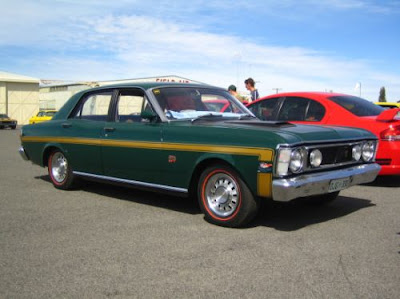
Now for a quick look at the ‘fleet’ colours that were offered by Ford on the GT. ‘Fleet’ colours were those available in the Ford paint catalogue that were not commercial or ‘corporate’ colours.
XR GT
Z782, Russet Bronze metallic - 1
XT GT
None
XW GT
Y145, Woodsman green - 2

Tuesday, March 04, 2008
Corporate Colours
Y107, Ansett Blue.
Ansett was an Australian airline founded by Reg Ansett in 1935. It went bankrupt in 2001. Originally the company was known as Ansett Airways, then Ansett Airlines of Australia, and finally Ansett Australia. In its final days, the aircraft tails were painted a striking blue shade, but in its heyday the aircraft carried an orange colour scheme.

Not much help if we are looking for a colour called Ansett Blue. However, here is an older picture of an Ansett aircraft, and yes, the paint scheme features blue.
 So, that could be the Ansett Blue, perhaps ? Now, all we have to do is compare it with the one, and only, XA GT that was painted Ansett Blue. This car still exists, and it is an RO83 car too. Unfortunately, the car has, at some point, been repainted Cosmic Blue. However, parts of the car are stilll visible in the original paint and the owner reports that it is like the XW colour Starlight Blue, but with some more green in it.
Here is a Starlight Blue XW GT for comparison with the aircraft above.

However, the tale of the Ansett Blue XA GT is even more interesting because the car was ordered to be painted Aluminium, just like 12 other XA GT’s.
 Except, somewhere during the ordering process, Y017 Aluminium became Y107, Ansett Blue. We bet the dealership, and the new owner, got a bit of a shock over that one.
 Perhaps as a final hint of what Ansett Blue looks like, there was also a trucking company called Ansett Freight Express, and here is one of their units. Could this be Y107, Ansett Blue ?

Subscribe to:
Posts (Atom)