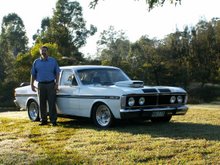
Nice colour and in good shape.
Showing posts with label XR6. Show all posts
Friday, February 27, 2009
Wednesday, January 28, 2009
Ford FG Falcon XR6 Turbo
First drive: Ford FG Falcon XR6 Turbo
Joshua Dowling, drive.com.au, April 10, 2008
The Falcon XR6 Turbo is the fastest Australian performance car. It’s also a great car to drive.

Meet the fastest Ford Falcon ever built – yes, even faster than the famous Falcon GT HO.
According to our satellite-assisted timing equipment, the XR6 Turbo can accelerate from rest to 100km/h in just 5.1 seconds and cover the quarter mile (or 400-metre sprint) in 13.4 seconds.
To make sure it wasn’t an error, we repeated the test. Again. And again. And again. Hey, someone’s got to do it.
For the record, the air-conditioning was on. There were no stunts, no tricks, we just squeezed the accelerator. It did it like it was brushing its teeth.
This not only makes the latest Falcon XR6 Turbo the fastest Falcon to date, it also shoots it to the top of the leader board in Australian performance cars. It’s faster than both the Holden V8s and its own big brother, the Falcon XR8 (which stopped the clocks at a comparatively slow 6.3 seconds).
Holden Special Vehicles claims its 6.0-litre V8 Clubsport can reach 100km/h in 4.96 seconds, but only HSV staffers have been able to repeat this figure. The best number any hacks like us have squeezed out of an HSV is 5.2 seconds. Perhaps that will change when the 6.2-litre Clubsport goes on sale in May 2008.
Meanwhile, the XR6 Turbo is the new king of the hill. For now. Its faster cousin, the Ford Performance Vehicles F6 Typhoon is also a month away and Ford engineers privately let on this week that it will perform the 0-100km/h dash in less than five seconds. We can’t wait, but in the meantime there’s the Falcon XR6 Turbo.
Previous Falcon XR6 Turbos stopped the clocks at about 5.9 seconds, so a 5.1 second 0-100km/h time is a phenomenal improvement. It’s largely the result of the massive changes Ford has made to the turbo, which is all new, and the larger intercooler, which is as big as the intercooler from the previous generation F6 Typhoon.
The power delivery is so smooth that, initially, you could be forgiven for thinking you’re not in the turbo at all. Until, that is, the turbo gets on the boil and all hell breaks loose.
As with the previous model, there is a subtle exhaust burble between gear changes and a deep roar as revs build. The six-speed auto is the pick of the bunch; while the manual has a launch control system, it also loses some turbo boost ever so slightly between gear changes.
Police lucky enough to have an Falcon XR6 Turbo as a highway patrol car are going to love the new model. If anyone is still clinging to the fantasy of Ford’s V8 power, then this car surely should shake sense into them.
As expected the Falcon XR6 Turbo is also good around corners, and Ford has again done an amazing job of blending handling ability and comfort. The steering is less nervous and more linear, but we did get some rack rattle in tight, bumpy turns. And the tyres can still be noisy at speed.
The brakes, which are carried over from the previous model, stood up to the punishment well. But, then again, the Falcon’s weight has changed little from the old to the new model so this shouldn’t come as a surprise. Those who want better stopping power can opt for the FPV Typhoon, which has four-piston Brembo brakes standard and six-piston brakes as an option.
In summary, first impressions of the XR6 Turbo are overwhelmingly positive, but we’ll reserve final judgment until we test it extensively on more familiar roads.
In the meantime, one final thought: the XR6 Turbo is reasonably well appointed but for one odd oversight. Curtain airbags aren’t standard on the quickest car in the range. What is Ford thinking?
Ford Falcon XR6 Turbo: Performance*
0-100km/h: 5.1 seconds
0-400m: 13.4 seconds
Top speed after 400m: 172km/h
* Performance figures conducted in controlled conditions using satellite-based timing equipment.
Joshua Dowling, drive.com.au, April 10, 2008
The Falcon XR6 Turbo is the fastest Australian performance car. It’s also a great car to drive.

Meet the fastest Ford Falcon ever built – yes, even faster than the famous Falcon GT HO.
According to our satellite-assisted timing equipment, the XR6 Turbo can accelerate from rest to 100km/h in just 5.1 seconds and cover the quarter mile (or 400-metre sprint) in 13.4 seconds.
To make sure it wasn’t an error, we repeated the test. Again. And again. And again. Hey, someone’s got to do it.
For the record, the air-conditioning was on. There were no stunts, no tricks, we just squeezed the accelerator. It did it like it was brushing its teeth.
This not only makes the latest Falcon XR6 Turbo the fastest Falcon to date, it also shoots it to the top of the leader board in Australian performance cars. It’s faster than both the Holden V8s and its own big brother, the Falcon XR8 (which stopped the clocks at a comparatively slow 6.3 seconds).
Holden Special Vehicles claims its 6.0-litre V8 Clubsport can reach 100km/h in 4.96 seconds, but only HSV staffers have been able to repeat this figure. The best number any hacks like us have squeezed out of an HSV is 5.2 seconds. Perhaps that will change when the 6.2-litre Clubsport goes on sale in May 2008.
Meanwhile, the XR6 Turbo is the new king of the hill. For now. Its faster cousin, the Ford Performance Vehicles F6 Typhoon is also a month away and Ford engineers privately let on this week that it will perform the 0-100km/h dash in less than five seconds. We can’t wait, but in the meantime there’s the Falcon XR6 Turbo.
Previous Falcon XR6 Turbos stopped the clocks at about 5.9 seconds, so a 5.1 second 0-100km/h time is a phenomenal improvement. It’s largely the result of the massive changes Ford has made to the turbo, which is all new, and the larger intercooler, which is as big as the intercooler from the previous generation F6 Typhoon.
The power delivery is so smooth that, initially, you could be forgiven for thinking you’re not in the turbo at all. Until, that is, the turbo gets on the boil and all hell breaks loose.
As with the previous model, there is a subtle exhaust burble between gear changes and a deep roar as revs build. The six-speed auto is the pick of the bunch; while the manual has a launch control system, it also loses some turbo boost ever so slightly between gear changes.
Police lucky enough to have an Falcon XR6 Turbo as a highway patrol car are going to love the new model. If anyone is still clinging to the fantasy of Ford’s V8 power, then this car surely should shake sense into them.
As expected the Falcon XR6 Turbo is also good around corners, and Ford has again done an amazing job of blending handling ability and comfort. The steering is less nervous and more linear, but we did get some rack rattle in tight, bumpy turns. And the tyres can still be noisy at speed.
The brakes, which are carried over from the previous model, stood up to the punishment well. But, then again, the Falcon’s weight has changed little from the old to the new model so this shouldn’t come as a surprise. Those who want better stopping power can opt for the FPV Typhoon, which has four-piston Brembo brakes standard and six-piston brakes as an option.
In summary, first impressions of the XR6 Turbo are overwhelmingly positive, but we’ll reserve final judgment until we test it extensively on more familiar roads.
In the meantime, one final thought: the XR6 Turbo is reasonably well appointed but for one odd oversight. Curtain airbags aren’t standard on the quickest car in the range. What is Ford thinking?
Ford Falcon XR6 Turbo: Performance*
0-100km/h: 5.1 seconds
0-400m: 13.4 seconds
Top speed after 400m: 172km/h
* Performance figures conducted in controlled conditions using satellite-based timing equipment.
Sunday, January 25, 2009
Ford FG Falcon XR6
First drive: Ford FG Falcon XR6
Toby Hagon, drive.com.au, April 10, 2008
Standard mechanicals meet performance styling in Ford's new FG Falcon XR6.

For many private buyers the new Ford Falcon XR6 is the logical choice. It picks up some of the styling attributes from the sportier XR models – XR6 Turbo and XR8 – but without the added cost of the extra performance.
The Falcon XR6 also offers a more appealing step up from the fleet-oriented Falcon XT. In reality, though, the driving experience of the Falcon XR6 is very similar to the Falcon XT.
That’s because the two share the same 195kW 4.0-litre six-cylinder engine mated to a five-speed automatic transmission.
Extensive work done to the Falcon’s most basic six-cylinder engine have liberated more power and, crucially, more torque, or mid-range pulling power.
The extra ratio in the automatic transmission – now with five forward gears instead of four – also delivers when it comes to performance, allowing the engine to operate closer to its ideal range.
The five-speed auto does shift smoothly, though, and doesn’t unnecessarily change down through the gearbox to a lower gear.
However, after calling on maximum performance the five-speed is sometimes too eager to shift up a gear or two. On a windy road with lots of accelerating and decelerating it can make the gearbox work harder than it needs to.
Thankfully there’s a semi-manual mode that allows the driver to sequentially select gears and hold them when required (pushing the lever towards the front of the car instigates a downchange while rearwards does an upchange).
A six-speed automatic transmission is also available, further boosting performance.
Drive used satellite-based timing equipment to measure independent performance figures for the basic engine and transmission combination (in a Falcon XT) and managed a 0-100km/h time of 7.1 seconds.
In everyday driving, the muscular engine still delivers plenty of easily accessible punch, matching the sporty sales pitch of the XR6 badge.
At the higher end of its rev range, though, the trusty six-cylinder gets quite vocal.
However, the engine is impressively smooth and willing to rev.
As with other models in the new Falcon range steering is also improved, providing a more secure high-speed feel.
A new steering system has eliminated the high-speed nervousness that characterised the BA/BF Falcons this new XR6 replaces.
Ford has added more weight to the steering at freeway speeds, delivering added security.
At the same time the new Falcon maintains its low-speed manoeuvrability with light steering effort and a tight turning circle (at 11.0 metres, Ford says the Falcon’s turning circle is class leading).
However, through bumpy corners on a country road the steering wheel can jiggle lightly as it knocks into bumps.
While the Falcon XR6 shares its basic mechanical package with the lesser XT, it does get unique suspension that is slightly firmer.
Through corners the Falcon XR6 sits down impressively and resists leaning when pushed.
Larger bumps, too, don’t upset the equation too much, while the stability control system is tuned to allow some spirited driving without getting into trouble. Our time in the Falcon XR6 included a stint on very slippery gravel, which had the stability system working furiously. But it still allowed respectable progress while reigning in any unwanted sliding.
Wind noise is, impressively, kept at bay at freeway speeds, while the standard 17-inch wheels and tyres create some roar over coarse bitumen surfaces.
The cabin is splashed with coloured trim that livens the interior treatment and is in keeping with the wing and spoilers on the outside.
Ford Falcon XR6: Performance*
0-100km/h: 7.1 seconds
0-400m: 15.2 seconds
Top speed after 400m: 150km/h
* Performance figures conducted in controlled conditions using satellite-based timing equipment. XR6 performance figures were obtained using a Falcon XT with the same 4.0-litre engine and five-speed automatic transmission.
Toby Hagon, drive.com.au, April 10, 2008
Standard mechanicals meet performance styling in Ford's new FG Falcon XR6.

For many private buyers the new Ford Falcon XR6 is the logical choice. It picks up some of the styling attributes from the sportier XR models – XR6 Turbo and XR8 – but without the added cost of the extra performance.
The Falcon XR6 also offers a more appealing step up from the fleet-oriented Falcon XT. In reality, though, the driving experience of the Falcon XR6 is very similar to the Falcon XT.
That’s because the two share the same 195kW 4.0-litre six-cylinder engine mated to a five-speed automatic transmission.
Extensive work done to the Falcon’s most basic six-cylinder engine have liberated more power and, crucially, more torque, or mid-range pulling power.
The extra ratio in the automatic transmission – now with five forward gears instead of four – also delivers when it comes to performance, allowing the engine to operate closer to its ideal range.
The five-speed auto does shift smoothly, though, and doesn’t unnecessarily change down through the gearbox to a lower gear.
However, after calling on maximum performance the five-speed is sometimes too eager to shift up a gear or two. On a windy road with lots of accelerating and decelerating it can make the gearbox work harder than it needs to.
Thankfully there’s a semi-manual mode that allows the driver to sequentially select gears and hold them when required (pushing the lever towards the front of the car instigates a downchange while rearwards does an upchange).
A six-speed automatic transmission is also available, further boosting performance.
Drive used satellite-based timing equipment to measure independent performance figures for the basic engine and transmission combination (in a Falcon XT) and managed a 0-100km/h time of 7.1 seconds.
In everyday driving, the muscular engine still delivers plenty of easily accessible punch, matching the sporty sales pitch of the XR6 badge.
At the higher end of its rev range, though, the trusty six-cylinder gets quite vocal.
However, the engine is impressively smooth and willing to rev.
As with other models in the new Falcon range steering is also improved, providing a more secure high-speed feel.
A new steering system has eliminated the high-speed nervousness that characterised the BA/BF Falcons this new XR6 replaces.
Ford has added more weight to the steering at freeway speeds, delivering added security.
At the same time the new Falcon maintains its low-speed manoeuvrability with light steering effort and a tight turning circle (at 11.0 metres, Ford says the Falcon’s turning circle is class leading).
However, through bumpy corners on a country road the steering wheel can jiggle lightly as it knocks into bumps.
While the Falcon XR6 shares its basic mechanical package with the lesser XT, it does get unique suspension that is slightly firmer.
Through corners the Falcon XR6 sits down impressively and resists leaning when pushed.
Larger bumps, too, don’t upset the equation too much, while the stability control system is tuned to allow some spirited driving without getting into trouble. Our time in the Falcon XR6 included a stint on very slippery gravel, which had the stability system working furiously. But it still allowed respectable progress while reigning in any unwanted sliding.
Wind noise is, impressively, kept at bay at freeway speeds, while the standard 17-inch wheels and tyres create some roar over coarse bitumen surfaces.
The cabin is splashed with coloured trim that livens the interior treatment and is in keeping with the wing and spoilers on the outside.
Ford Falcon XR6: Performance*
0-100km/h: 7.1 seconds
0-400m: 15.2 seconds
Top speed after 400m: 150km/h
* Performance figures conducted in controlled conditions using satellite-based timing equipment. XR6 performance figures were obtained using a Falcon XT with the same 4.0-litre engine and five-speed automatic transmission.
Subscribe to:
Posts (Atom)