Showing posts with label XR. Show all posts

Tuesday, February 03, 2009

XR GT


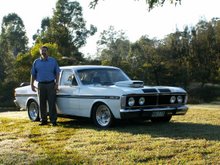
In 1968 the XR model began the legend that was to be the GT. This family car muscled out 225HP thanks to the 289 Windsor V8. The start of the Falcon GT's was only sold in one colour - Gold.

596 of these made it into production. The GT versions of the Falcon are probably the most famous of the breed, and certainly the most desirable and collectable today.

What inspired Ford of Australia to produce such a car can be reduced to a single word: Bathurst. In its early years, the annual 500 mile race at the mountain road course of Mount Panorama, Bathurst attracted many entrants driving a wide variety of foreign and domestic cars, including the first purpose built local Ford 'race' car, the Cortina GT500.

In 1967, however, Ford were keen to showcase their current image car, the Falcon, and with the arrival of the XR model, which for the first time in the Australian Falcon was available with a V8 engine, they set about planning something different.

In many respects, the development of the XR GT benefitted from the gathering of several happy coincidences. First was having the right men at the right place. Bill Bourke was the then Assistant General Manager of Ford Australia and he was passionate about racing, and, inspired by the success of racing V8s, both in Australia and in his native U.S. he felt sure that a sporting XR Falcon could be a winner.

He passed the idea over to Harry Firth, who was Ford's tuner and race car preparer and had been so successful in developing the GT500 Cortina and who had been working on beefing up the XR after a request from the Victorian police for a heavy duty pursuit vehicle.

Firth saw that, taking the best bits from the police package and introducing some more horsepower in the engine, a sporting Falcon GT could be developed. At the same time, the news and media, especially live television, were focussing on the annual Bathurst event and creating a valuable and unique advertising opportunity for any manufacturer willing and able to win the race by lasting the 500 miles.

And finally, Henry Ford II, had set Ford on its 'Total Performance' track. Motor sport dominance was his aim. If in the U.S. that meant Nascar and the dragstrips, and in Europe it meant forest rallying and Le Mans, in Australia it meant touring cars and conquering the Mountain.

http://www.uniquecarsandparts.com.au/car_info_ford_falcon_xr_gt.htm

Saturday, January 19, 2008

The Corporate Colours 3

If you have been doing the maths you will see we have accounted for 9 of the 13 non GT Gold cars. For the record, the other four cars were one of each:.

Russet Bronze metallic, which was another non-option paint colour, Z782.

Sultan Maroon metallic, which was option code ‘F’. This was the car entered by Bob Jane and Spencer Martin in the 1967 Gallaher 500.


olar White, option code ‘E’. This was the car raced by the Geogeghan Brothers at the 1967 race.


Ivy Green metallic, option code ‘X’. This was the race winning car of Fred Gibson and Harry Firth.

Wednesday, January 16, 2008

The Corporate Colours 2

F166 - Gallaher Silver


Gallaher commissoned Ford to build 8 XR GT’s painted colour F166, Gallaher Silver, and used them for promotion work. At the time Gallaher was sponsor of the 500 mile race at Mount Panorama, Bathurst; Ford were keen to enter their new XR GT model in the race; and Gallaher had a new range of cigarettes to promote, the GT King Size Filter. Hence, they all came together, to great effect, on the 1st of October, 1967.


Sunday, January 13, 2008

The Corporate Colours 1

We will restrict our examination of corporate colours to the GT model, for the simple reasons that the GT Falcons are the only models for which extensive figures and research has been released by Ford Australia, and the GT is now a highly collectable car with much interest shown in the cars providing a wide and historic photo database. As ever, we are highly indebted to the Falcon GT Club of Australia, their members, site webmaster and historian.

XR GT

The XR GT is most famously known for introducing the GT Gold paint colour, and most folk would be mistaken for believing that all XR GT’s were painted this colour. Of the 684 manufactured, 671 were gold, and 13 were not. These 13 cars were split between six further different colours, four of which were standard option colours for the XR model Falcon, and two of which were special ‘corporate’ colours.

F131 - Avis White


n this context, F131 is the Ford fleet representation. The colour scheme was also known as Y131, and it is the ‘Y’ code that most commonly appears on the compliance plate in the paint section as an alternative to the single digit alphanumeric code. The Dulux formula for Avis White is 8986. There only seems to be one ‘Avis’ colour listed in the Ford charts, and it is this white. This car was built for a Ford executive.

Sunday, August 05, 2007

Saturday, August 04, 2007

XR GT wheels

XR GT’s had a 5.5 inch rim which was manufactured by Rubery,Owen and Kelmsley (ROK Australia). They had a fully polished stainless steel hubcap which came from the 1966 Mercury Comet Cyclone GT in the U.S. Special chrome wheel nuts were used that protrude through the hubcap. Wheel diameter was 14 inches.


Saturday, July 14, 2007

XR Falcon

Whereas the previous four ranges of Falcon tended to follow styling trends set by their full size US parent cars, and were marketed with reference to the ‘Thunderbird’, it was decided with the new XR range, which again followed a US design, to capitalise on the phenomenal success of the Mustang. The styling of the car was inspired by the Mustang, copying the coke bottle style line, and the long bonnet and short boot cue, but retaining the traditional round tail lamps. The result was a car that was modern and handsome and while the two door hardtop model disappeared, this was more than compensated for by the arrival, for the first time in the Australian Falcon, of the 289ci (4.7litre) V8 and some serious horsepower.
The XR was manufactured between September, 1966 and April, 1968. 87270 were produced.

Thursday, July 12, 2007

Option 86
While talking about vents, it is worth while noting Option 86, which was available on XA and XB four door Falcons. While looking at pictures of the XR to XY Falcons which were designed and styled for the sixties, you can see that they had front quarter windows. When the Australian designed and 1972 released XA Falcon arrived, Ford were keen to promote their new through flow ventilation system which would render the need for quarter windows redundant. However, somewhere along the line they must have had doubts because they offered Option 86, which was the fitting of front side glass with quarter windows. This was not a option that was much specified by buyers, and, there has been debate as to actually why it was offered. Was it for the benefit of smokers, or was it for cars sold in areas of Australia where very hot weather was the norm ? It would be interesting to find out

Here are a couple of pictures of XBs with the quarter windows. Ironically, both are XB GTs, and both are painted code F - Frosted Lime - which was in itself a rare colour choice for the GT.


Sunday, June 03, 2007

XY GS

Once again the GS Rally Pack was available on the XY model. In addition to being available on the Falcon 500, Futura and Fairmont sedans, it was also now an option on the Falcon 500 and Fairmont wagon also.

The actual GS options remained the same including the GT dash featuring speedometer, tachometer, odometer, oil pressure, water temperature and fuel gauges, but some other items crept onto the general option list, most notably a sunroof and a stereo radio/tape player. For performance enthusiasts, the most important option was now a 250hp two barrel carburettor equipped Cleveland version of the 351ci V8. It may not have rivalled the 290hp GT, but it really wasn’t too far off now.


This is a lovely XY GS in Onyx Black showing the GS stripe terminating in the GS badge and the chromed XR/XT GT lookalike wheel covers


Here are close ups of the stylised GS badge and of the wheel cover.

Saturday, June 02, 2007

XW GS

Available on the Falcon 500, Futura and Fairmont sedan, the GS added the following features; GS Rally stripes that ran from the front indicators to the middle of the rear wing and ended with the GS insignia and full wheel covers that were the same as the stainless steel wheel covers used on the XR and XT GT models. Inside, a three spoke, deep dished wooden rimmed steering wheel with rim squeeze horn and full dash instrumentation were the same as on the GT model.

From there the buyer could then run riot through the normal options list adding; bucket seats and sports console with four speed or T-Bar automatic, a 302ci 220hp V8, power disk brakes, air conditioning, tinted windscreen, vinyl roof; anything, in fact, that was available in the catalogue. Ford advertised the GS as - ‘Make up your own Grand Sport’ - and, while the car did not have the appeal of the GT, it did offer the cost conscious a distinctive alternative.


Friday, March 09, 2007

XW GT - The Super Roo


Following the sales success of both the XR and XT GTs, Ford Australia decided that the GT would continue in its upcoming model and in May 1969, production of the XW GT - flagship of the XW Falcon range - commenced. However the new GT was a far cry from the relatively subdued XT GT.
The new model was much bolder and meaner looking, with a new front and rear end treatment, a large range of striking colours, blackouts around the doors and on the bonnet, bonnet scoop, driving lights, chrome strips, badges on the guards and boot lid, a big wide stripe down each side and a decal of a V8 powered kangaroo burning rubber, described as the Super Roo. The new GT certainly made an impact and was not the type of car for those looking for anonymity.
Mechanically, the 302 cu.in. V8 in the XT GT was initially replaced by the larger and more powerful 351 cu.in. version of the Windsor motor. This increase in size, along with compression being raised from 10 to 1, to 10.7 to 1, increased engine power from 230 HP at 4800 rpm to 290 HP at 4800 rpm and torque from 310 lbs/ft at 3800 rpm to 385 lbs/ft at 3800 rpm. To handle the extra power and torque, the XW GT received the venerable Ford 9 inch limited slip diff, running 3.25:1 gears. As with the XT GT, automatic transmission was also available in the XW GT, however the stronger FMX auto replaced the C4 auto of the previous model.
With the growing importance of the Bathurst race, a number of other changes were made to improve the XW GTs race winning potential. These included stiffer suspension, 11.25 in. ventilated front disc brakes and an enormous 36 gallon fuel tank - obviously to minimise fuel stops in the great race. Wheels and tyres were also upgraded to 6.0 in. wide Kelsey Hayes riveted ‘12 slot’ rims running ER 70 x 14 HR Dunlop SP or Olympic ‘Wide Ride’ radial ply tyres.
Although these changes made the new GT a much more performance oriented vehicle than it’s predecessor, the XW GTs increased weight ensured that its top speed (125-130 MPH) and quarter mile times (15.5-16.0 sec.) were very similar to those of the XT GT. Only in the 0-100 MPH times (20.3-20.9 sec) did the XW GT show its potential, being around 3 sec. quicker than the XT GT.
It is generally accepted that Windsor powered XW GTs were produced up until the end of February 1970, with total production up to this point being 1268 vehicles. The exact change over date for the Cleveland engine is however unclear and some may have continued into March 1970. At a cost of only $4250 incl. tax, the new GT was considered by ‘Wheels’ magazine, to be “the best performance bargain in Australia”.
As good as the new model was, the factory wanted something better to race at Bathurst and so an even more potent version - the XW GTHO - was developed.
THE GTHO
Production of the XW GTHO - with HO standing for Handling Option (not High Output) - commenced in July 1969. Changes from the standard model included replacing the cast iron inlet manifold and Autolite 450 cfm carburettor with a Ford (Buddy Bar) aluminium inlet manifold and 600cfm Holley carburettor (similar to the one used on the 390 Mustang GT), a bigger cam, heavy duty alternator, a 3 in. tailshaft, bigger front sway bar and a rear sway bar. For marketing reasons, Ford still claimed only 290 bhp for the GTHO - the same as for the standard XW GT, even though it was obviously more powerful. So special was the GTHO, that Ford gave it a different model number (18939) compared to the standard GT (18938). Interestingly, this convention was not carried through to the Phase 3, with the XY GT and HO of that year, having the same model number. More about the vagaries of model numbers for a later issue.
Although top speed for the GTHO (130 MPH) was similar to the standard model, how it got there was a vast improvement over the GT. The quarter mile times (14.4-15.0 sec.) show a dramatic improvement over the GT, with the 0-100 MPH times (16.7-16.8 sec) confirming its acceleration capabilities.
Having produced a 1-2-3 victory at the Sandown 3 Hour race only weeks before, great things were expected of the GTHO at Bathurst, on that first weekend in October. Everything looked good in practice and qualifying. The Geoghegan brothers took pole position with a time of 2:48.9 sec. - nearly 8 sec. faster than in 1968 - and the GTHOs were able to reach 136 MPH down Conrod Straight, compared to 130 MPH for the Monaros.
Unfortunately history shows that even the best laid plans can often go astray. Apart from a massive accident on the first lap, where Bill Brown rolled his GTHO coming off the top Skyline, the main thing that stopped a Ford victory on the day of the big race, was the selection of untried Goodyear racing rubber by the Ford works racing team manager Al Turner. A non-factory GTHO driven by running XAS Michelins almost took out the race and finished 2nd by only 44 seconds.
Where the Monaros were lapping in 2:55s, the GTHOs were lapping in 2:52s. Interestingly, Ford - quick to try to negate the effect of their loss to Holden - ran an advertising campaign which showed a photo of destroyed Goodyear tyres in front of a GTHO having its rear tyres replaced and with the caption "We were a little deflated".
Production of Windsor powered GTHOs stopped in December 1969 with a total of around 260 being built - making them one of the rarest GTs. Cost of the GTHO was only $4495 - just $245 more than the standard model - to ensure that it was still eligible for Class D ($3100-$4500) at Bathurst. If ‘Wheels’ considered the GT to be a bargain, then the GTHO must have been a steal.
Unfortunately, the original GTHO will always be remembered as the car that lost Bathurst, even though it was a winner on the road. Such was the demand for the GTHO, that in early 1970 - prior to the introduction of the Phase 2, Ford produced around 57 GTHOs using the Phase 1 running gear, but with a standard ‘Cleveland’ 351 4V engine. Commonly refereed to as Phase 11/2s, these are some of the rarest of the full production GTs.

The CLEVELAND
The ‘Cleveland’ designation for the 351 cu. in. motor fitted to XW GTs built from March 1970, comes from the location of the engine plant where they were originally assembled; Cleveland, Ohio, in the USA. (Windsor motors were assembled in
Windsor, Ontario, in Canada) Although having the same capacity, bore and stroke as the 351W, the 351C was a completely different motor, with completely different characteristics. Where the ‘Windsor’ was designed to be very robust and torquey, the 4V ‘Cleveland’ as used in the GT was designed more with outright performance (horsepower) in mind. Revised sizing of journals and extra large intake and exhaust valves and ports enabled the new motor to rev a lot harder than the previous one.
Mechanically, the 351C had an increased compression ratio of 11 to 1, provided peak power of 300 BHP at 5400 rpm (10 BHP more than the 351W at 600 RPM higher) and peak torque of 380 lbs/ft at 3400 rpm (5 lbs/ft less than the 351W at 400 RPM lower). With the extra power Ford decided to lower the diff ratio from, 3.25:1 to 3.00:1.
Apart from the engine, the only other obvious changes were to the tachometer (increased from 6000 RPM to 8000 RPM) and the oil pressure gauge (increased from 80 psi to 100 psi). Although initially fitted with the Kelsey Hayes riveted ‘12 slot’ rims, in May 1970 Ford introduced the Kelsey Hayes riveted ‘5 slot’ rims, still running ER 70 x 14 HR Dunlop SP or Olympic ‘Wide Ride’ radial ply tyres. Performance of the Cleveland powered XW GTs was similar to the Windsor powered ones. Although the change in diff ratios ensured a slightly higher top speed (130-135 MPH) for the Cleveland powered XW GTs, it also meant that acceleration figures remained fairly similar..
Having commenced in March, production of the Cleveland powered XW GTs continued on until some time in October 1970, with total production up to this point being around 1019 vehicles. With the production of XY falcons commencing in September 1970, it is interesting to note that some of the late XWs were fitted with XY radiator support panels whilst some early XYs were fitted with XW radiator support panels.
With the failure of the XW GTHO (Phase I) to win at Bathurst in 1969 (although not the fault of the car), Ford decided to go all out in developing its new Bathurst weapon, the Cleveland powered XW GTHO (Phase II).
THE GTHO (Phase II)
Production of the XW GTHO (Phase II) commenced in June 1970. Changes from the standard model included modifying the cast iron inlet manifold and replacing the Autolite 450 cfm carburettor with a Ford 750cfm Holley carburettor, a fairly lumpy solid cam with coresponding upgrades to the valve train, heavy duty alternator, a 31/2 in. tailshaft with larger universal joints, bigger front sway bar and a rear sway bar, revised front and rear spring rates, unique upper control arm and spindle to provide an increased front track, 31 spline close ratio gearbox, 3.50:1 diff with nodular iron housing and 31 spline axles and 21/2 in. wide and finned rear drums. For marketing reasons, Ford still claimed only 300 bhp for the GTHO - the same as for the standard Cleveland XW GT, even though it was much more powerful.
Even with the lower diff ratio, top speed for the new GTHO was improved (135-144 MPH). Although acceleration for the new GTHO was also a vast improvement over the standard GT the quarter mile times provided by the testers of the day were fairly inconsistent (14.2-15.2 sec.). Interestingly, these figures along with the 0-100 MPH times (16.7 sec) were almost identical to those of the Phase I. In fact the Phase I was equally as good as the Phase II in many respects, much to the surprise I’m sure, of a lot of you.
BATHURST 1970
Although Moffat provided a win in the Sandown 250 race only weeks before, mechanical problems plagued the rest of the HOs entered and this lack of reliability of the new HO provided some concern to the Ford camp in the lead up to Bathurst. But they should not have worried, as the mountain is a place where the Fords excel. As in 1969, everything looked good in practice and qualifying. The new GTHOs filled the first three positions on the grid, with Moffat taking pole with a time of of 2min 49.0sec.; surprisingly slower than Geoghegan’s time of 2 min 48.9sec. in 1969.
With the experience of 1969 behind them and no untried Goodyear racing rubber the factory GTHOs driven by Moffat and McPhee, ran faultlessly all day and although having a good battle with the XU-1 Toranas of Bond and Chivas, were able to make it a Ford 1-2 victory. Moffat also set a new Class E race lap record of 2 min 55.0sec, again slower than his Class D race lap record of 2 min 52.1sec set in the Phase I.
Official records indicate that production of the proper Phase II GTHOs stopped in October 1970 with a total of around 292 (not including the Phase 11/2’s) being built. Cost of the Phase II was only $4790 - just $425 more than the standard model.
With the push towards total performance, production racing wasn’t the only area of motor sport that Ford was interested in. With Ian (Pete) Geoghegan and Moffat having had a great deal of success in touring class racing with their Mustangs, Ford decided to develop their own car for improved production. The car that we all know of as the Geoghegan Super Falcon, actually started life as an XW GTHO. Two cars were originally built, with one for use by Moffat (see photos).
As can be seen from the picture of the engine bay, with the fuel injection pipes sticking up, this was a car that meant business. Ford spent a lot of money developing these cars, and although they proved to be very quick, they were unfortunately also a little unreliable.
Whilst the original GTHO will always be remembered as the car that lost Bathurst, the Phase II was the one that restored the faith in the Ford hierarchy of the benefits that could be achieved from an involvement in motorsport - “Win on Sunday, Sell on Monday”.
With success at the mountain and a new model (XY) being released to the public with rave reviews (especially the ‘Shaker’ XYGT), Ford could do no wrong. As good as the Phase I and II had been, Ford had something better waiting in the wings. In late 1970, the first XYGT buyers had the opportunity to get a taste for what was to come. They could order, as a $425 option, a Phase II engine for their XYGT. Now that would have been an interesting proposition.

Wednesday, March 07, 2007

XR GT - The Legend Begins


As the first article on Falcon GTs, I thought it appropriate to start with the model which started it all, the XR GT. The XR GT was introduced to the Australian public in April 1967 and was based on a ‘police special’ pursuit vehicle developed for the Victorian police force. The major purpose for the model’s introduction, was however to win the Gallaher 500 at Bathurst.
Ford had a very successful history at Bathurst, with the Cortina GT taking both line and class honours in 1963 & 1964, whilst the Harry Firth developed Cortina GT500 won again in 1965. Due to changes in the homologation rules, the Cortina GT500 was ruled ineligible in 1966, so Ford needed a new weapon to compete with in 1967, in this ever increasingly important annual event.
At this time, Ford had just introduced the XR Falcon range, which for the first time included a V8 option. With development of special V8 police “pursuit” vehicle well under way, Ford’s then Managing Director, Bill Bourke, saw an opportunity to develop this into a Bathurst contender, as well as giving the company an image leader in the growing youth market.
The job of transforming what was still basically just a family sedan, into a car capable of winning Australia’s toughest production car endurance race, was given to Don Dunoon, Malcolm Inglis and Harry Firth (the Silver Fox); the latter being so successful in not only developing the Cortina GT500, but also securing victories for Ford in racing and rallying.
The major mechanical changes made from the standard 289 cu.in. V8 model involved modifications to the engine, suspension, brakes and transmission. Using high crown pistons, which raised compression to 9.8 to 1, four barrel carburettor with chrome air cleaner, a revised camshaft profile and revised exhaust manifolds, the power of the engine was raised to 225 HP, whilst torque was raised to 305 ft/lbs.
Suspension modifications included a 16 to 1 steering box, stiffer front and rear springs, a bigger front stabiliser bar and 5½ ” steel rims with 185x14 Olympic GT radials. Brakes were 11” discs on the front and 10” drums on the rear, servo assisted. Transmission was the legendary Ford 4 speed “top-loader” mated to a 2.93 to 1 ratio diff.
The job of making the car look good, was given to Jack Telnac, Ford Australia’s first resident stylist. Externally, this included the “any colour you like, as long as its GT Gold” colour scheme, with GT badging, “side-winder” GT stripes, grille black-outs and chrome wheel covers.
Internally, the Fairmont based cabin was decked out in charcoal (not black) vinyl, Stewart Warner instruments, Hurst style manual gear shifter and Mustang style imitation wood rimmed steering wheel, with a big padded boss in the centre. In 1967, this was the trickest piece of gear around.
Performance figures for the XR GT varied from road test to road test, however top speeds indicated were generally over 120MPH, whilst the best standing quarter mile time given, was 15.8 sec. Not bad for a 1967 car that only cost $3,890 (inc. tax).
Although Ford initially only planned to produce 260 vehicles to meet the homologation requirements for Bathurst, demand was so great that more than double this amount were produced, before the next model GT was introduced. So unsure were Ford of the viability of a GT Falcon, that the first batch produced didn’t even have a handbook and the workshop manual supplement was included with that for the XT GT. The final figure however, is subject to debate but is around 684, with some of the unfilled orders being transferred to the XT GT.
As we know, the gamble to produce the Falcon GT paid off, with the Falcon GTs of Harry Firth/Fred Gibson and Leo and Pete Geoghegan taking out first and second places respectively. In winning the race, the Firth/Gibson car put in a fastest lap of 3min. 3sec. and was clocked down Conrod straight at 125.69MPH.
Some interesting facts about the XR GT that many people might not be aware of, include the fact that not all XR GT’s were painted GT gold. Eight were painted “Gallaher Silver” as promotional vehicles for the Gallaher cigarette company, the 1967 race winning car of Harry Firth and Fred Gibson was “Ivy Green” metallic, (as depicted in the Trax model), one was bronze, one was maroon and the remaining two were different shades of white. Also, some of the last XR GT’s produced had 302 motors instead of the 289 and rumour has it that there was also a factory automatic produced, supposedly last seen running around Brisbane.
At the 1997 Nationals – that being the 30th anniversary of the XR GT – Harry Firth was given the honour of being the guest speaker at the presentation dinner. Although he may have been getting on in years, Harry’s recollection of the time he helped Ford develop the GT Falcons, was as clear as ever.

Saturday, January 27, 2007

XR Falcon (1966-8)


To match the standard of living, Ford went for a larger car, the all new XR Falcon. Designed in Australia, it was still based on the American Falcon.Styling of the XR was inspired by the hugely popular US Mustang, and turned heads right around Australia. It proved a winner, achieving big sales.


The new Falcon came with an optional V8 engine, a 289 cubic inch unit that produced 200bhp at 4400rpm. The Pursuit 170 and Super Pursuit 200 six cylinders remained with minor improvements; the 144 was scrapped. The wheelbase was slightly stretched, front disc brakes were offered across the range and the 13 inch wheels were replaced by a 14 inch variety. XR broke new ground in suspension, body frame and chassis design, and was the first model developed at You Yangs. For the second time, a Falcon won the Wheels Car of the Year award.


The XR has a very different appearance to the previous models, due to its long nose and short tail styling with a distinctive kick up at the back of the rear doors, which is known as the "Coke bottle" hip.Inside, the instrument panel was restyled, and lap seat belts were made standard, but only on the front seats. New additions to the options list included a remote boot release and a stereo tape player.