Sunday, April 22, 2007

So where are the cast marks ?


If they are present, they are in the top corners of the cylinder heads, visible because the rocker cover has its corner angled. In the photos above and below, you can see the ‘4’. These are XW GT’s.


And the ‘4 dot’ ?


As fitted to XA’s.

Saturday, April 21, 2007

Don't avoid the void

"When we feel stuck, going nowhere -- even starting to slip backward -- we may actually be backing up to get a running start." -- Dan Millman

To change, we must go through a transition zone. It's not easy being in transition. Thoughts, beliefs and habits are all in flux. It can create a sense of groundlessness, of being in a void that can be quite uncomfortable.
When we’re in the void, our first impulse will be to revert to old habits because they feel comfortable. Our goal is to hang in there until the change is complete. Knowing that TRANSITIONS ARE PART OF THE CHANGE PROCESS helps us muster the courage to put up with the discomfort, the uneasiness, the void.
Change requires a letting go of what we’ve always known and done to allow in something new. We need to trust ourselves and higher forces to unfold a new reality for us.

"Every positive change - every jump to a higher level of energy and awareness - involves a rite of passage. Each time to ascend to a higher rung on the ladder of personal evolution, we must go through a period of discomfort, of initiation. I have never found an exception." -- Dan Millman

Help

A lady walks into the drugstore and asks the pharmacist for some arsenic.
"Ma'am, what do you want with arsenic?"
"To kill my husband."
"I can't sell you arsenic to kill a person!"
The lady lays down a photo of a man and a woman in a compromising position.
The man is her husband and the woman is the pharmacist's wife.
He takes the photo, and nods.
"I didn't realize you had a prescription!"

Cleveland cylinder heads

To fit 351C engines, it is generally accepted that there are seven types of production Cleveland heads that you may come across, five U.S. and two Australian.

They are:-
U.S. 4V Closed chamber with a ‘4’ cast in the corner
U.S. 4V Open chamber with a ‘4’ cast in the corner
U.S. 4V Closed chamber with a ‘4’ and a ‘dot’ cast in the corner
U.S. 2V Open chamber with a ‘2’ cast in the corner
U.S. 2V Open chamber with a ‘2’ and a ‘dot’ cast in the corner
Aus 2V Open chamber with nothing cast in the corner as fitted to Aus 351C
Aus 2V Closed chamber with nothing cast in the corner as fitted to Aus 302C

To take them in turn.

The U.S. 4V closed chamber head with the ‘4’ casting is the head fitted to the CK608 and CK609 engines installed in XW and XY GT’s. These heads were fitted to imported ‘D’ block engines.

The U.S. 4V open chamber head was not fitted to any Australian Ford.

The U.S. 4V closed chamber head with the ‘4’ and ‘dot’ casting is the head fitted to the CK617 engines installed from mid 1972 XA through to end of 1973 XB manual transmission equipped GT’s. It has a slightly larger chamber than the ‘4’ only casting with a resultant half a point compression drop in C.R. These engines were imported ‘square’ block engines.

The U.S. 2V open chamber head with the ‘2’ casting is the head used on the CK601 and CK604 engines in XY’s and ZD’s. These were imported ‘D’ block engines.

The U.S. 2V open chamber heads with the ‘2’ and ‘dot’ casting in the head were used on the CK614 engines fitted to late XY’s and ZD’s. These engines were imported ‘square’ block engines.

The Aus 2V open chamber head with no casting mark is the head fitted to Australian built 351C’s fitted to XA’s through to XE’s with both four barrel and two barrel carbs.

The Aus 2V closed chamber head with no casting mark is the head fitted to Australian built 302C’s fitted to XA’s to XE’s with two barrel and four barrel carbs. It has the smallest chamber size of any of the production Cleveland heads.

Friday, April 20, 2007

A willingness to try something new

“It is so easy to waste our lives: our days, our hours, our minutes. ... It is so easy to exist instead of live. Unless you know there is a clock ticking. So many of us changed our lives when we heard a biological clock and decided to have kids. But that sound is a murmur compared to the tolling of mortality.” - Anna Quindlen

Time off

An employee comes into her manager’s office to take a day off from work. The manager replies, "So you want a day off? Let's take a look at what you are asking for. There are 365 days per year available for work. There are 52 weeks per year in which you already have 2 days off per week, leaving 261 days available for work. Since you spend 16 hours each day away from work, you have used up 170 days, leaving only 91 days available. You spend 30 minutes each day on coffee break, which counts for 23 days each year, leaving only 68 days available. With a 1-hour lunch each day, you used up another 46 days, leaving only 22 days available for work. You normally spend 2 days per year on sick leave. This leaves you only 20 days per year available for work. We are off 5 holidays per year, so your available working time is down to 15 days. We generously give 14 days vacation per year which leaves only 1 day available for work and I'll be darned if you are going to take that day off!"

Cleveland engines part 10

For XA GT’s, the switch to square blocks appears to have taken place in May or June, 1972 for automatic trans equipped cars, and in August or September, 1972 for manual trans cars.
As mentioned earlier, the square block seems to have appeared in the U.S. in 1971, as the engine fitted to 1971 Boss351 Mustangs were square blocks, as below.


It is worth noting also that Boss351 blocks were also four bolt main blocks.
Australian manufactured blocks have the letters ‘GF’ cast into them at the rear, upper surface beside the oil pressure gauge adaptor. ‘GF’ stands for Geelong Foundry.


US blocks had ‘CF’ for Cleveland Foundary cast here, and some early Australian cast blocks were ‘CF’ as well as they used the US casting moulds initially.The change from ‘C’ to ‘G’ would have been relatively easy to carry out.

Thursday, April 19, 2007

‘D’ block or the ‘square’ block


The terms ‘D’ block and ‘square’ block apply to differences in the casting of the engine block. The ‘D’ block is the earlier casting, in fact the initial casting of the 351C block and the ‘square’ block is the later one. How much later is open to conjecture. ‘Square’ blocks would appear to have been available in the U.S. in 1971, and there is some evidence to show that the ‘square’ block appeared in automatic XY 351C 2V’s as early as May, 1971, and in manual XY 351C 2V’s in December, 1971. It does appear that XY 351C 4V engines continued with ‘D’ blocks. What can be said though is that no XW or XY GT came with a square block, and that all Australian built engines are patterned after the ‘square’ blocks.

The ‘D’


The ‘D’ can be seen on the cast extension on the front of the block, adjacent to the petrol pipe.


Compare with the later square block.


Wednesday, April 18, 2007

Fake it

"Fake it till you make it." Mary Kay Ash, founder of Mary Kay Cosmetics

Please explain

"Do you believe in life after death?" the boss asked one of his employees.
"Yes, sir," the clerk replied.
"That's good," the boss said. "After you left early yesterday to go to your grandmother's funeral, she stopped in to see you."

Tuesday, April 17, 2007

Quotable quotes

"Use your health, even to the point of wearing it out. That is what it’s for. Spend all you have before you die; and do not outlive yourself." George Bernard Shaw

Doctor?

An acquaintance of mine who is a physician told this story about her then-four-year-old daughter. On the way to preschool, the doctor had left her stethoscope on the car seat, and her little girl picked it up and began playing with it. Be still, my heart, thought my friend, gee, my daughter wants to follow in my footsteps and be a doctor! Then the child spoke into the instrument: "Welcome to McDonald's. May I take your order?"

Cleveland engines part 8

Some of what the descriptions mean will be explained below.
Regarding coil tags, and by way of comparison to the previous one, here is the tag for an early XY GT.


This shows that it is a:- ‘351C’, engine; ‘70’, model year; ‘1’, first version; ‘A18’, 18th of January engine build; and ‘CK609A1’ engine code. This is a ‘D’ block code.


As a check, here is the block from that engine showing the casting numbers:- ‘DOAE-J’, is the ‘D’ block casting and - not too well reproduced - under it is the casting date, ‘9M13’, 13th of December, 1969.
t was mentioned above that in the US they changed to engine code stickers in February, 1973. This is what they looked like, and note they were on the drivers side - in Australian terms - front face of the rocker coverand not the pax side.

Monday, April 16, 2007

Create happiness right now

"It is our basic right to be a happy person, happy family, and eventually a happy world. That should be our goal." - Dalai Lama

Little adjustments to our attitude and approach each day can create a major difference in our appreciation of life. On the surface, nothing changes. At the same time, absolutely everything does. Use your awareness or your imagination to bring happiness to this moment. Find something to appreciate. Do this as often as you remember to do so, and your world will transform.

" ... we can no longer afford to throw away even one ‘unimportant’ day by not noticing the wonder of it all. We have to be willing to discover and then appreciate the authentic moments of happiness available to all of us every day." - Sarah Ban Breathnach

Be careful what you wish for...

Married couples, both 60 years old, were celebrating their 35th anniversary. During their party, a fairy appeared to congratulate them and grant them each one a wish. The wife wanted to travel around the world. The fairy waved her wand and poof - the wife had tickets in her hand for a world cruise.
Next, the fairy asked the husband what he wanted. He said, "I wish I had a wife 30 years younger than me."
So the fairy picked up her wand and poof - the husband was 90.

Cleveland engines part 7

Originally in the U.S. this number was on a metal tag that was attached to an ancilliary bracket or more usually sandwiched under the coil mounting bracket, but later in life they were reduced to a white paper sticker on the front of the right hand valve cover. For some reason, which is still a bit of a mystery, the 351C’s built in the U.S. and shipped for export acquired the letter ‘C’ in front of the ‘K’ and became CK601, CK604, CK608, CK609, CK614, CK616 and CK617, and this is what appeared on the paper tag on engines fitted in Australia. There is a some credence to the thought that the ‘C’ stood for ‘Canada’ as they initially received non-emission export engines, and for simplicity, the ‘CK’ then applied to all export engines. It is also worth mentioning that in the US the switch from using a metal tag to a paper decal took place in February, 1973, yet the paper decals were appearing on Australian engines before that.
Here is an example of a coil tag that was fitted to an XA GT RPO83.


What is interesting about this tag is that XA GT RPO’s were built in August, 1973. The tag decodes as - ‘351C’, the engine; ‘72’, the model year; ‘5’, the change level or version; ‘G26’, 26th of July assembly date; and ‘CK617J1’, the engine code. On U.S. tags there is usually a digit in front of the ‘G26’ which signifies the year of production. The year is missing on this Australian or export tag which may have been a a deliberate policy to allow Ford to stockpile export engines, either in the U.S. or at their destination.
It is also worth mentioning that the equivalent paper tag for this engine reads ‘CK617J1-W’ and it signifies a special order, manual transmission only square block import engine with big port heads. Some more of what this means is explained below.
Here is an example of the paper tag for a ‘CK608’ engine, showing its location.

As these paper tags appear in several of the pictures I'll use over the next few days, here is a breakdown of their significance:
CK608 A1 70-1 - manual D block 4 heads (XW-XA)
CK609 A1 70-1 - auto D block 4 heads (XW-XA)
CK616 J1 71-3 - auto D block 4 dot heads
CK616 J3 72-5 - auto D block 4 dot heads (1971 casting
CK616 J3 72-5 - auto square block 4 dot heads (1972 casting)
CK617 J1 71-1 - manual D block 4 dot heads
CK617 J1 72-5 - manual square block 4 dot heads
CK617 J1W 72-5 - manual square block 4 dot heads

The Innovation Leader

by Bob Rosenfeld: Making the Invisible Visible
Thirty-five years ago, Bob Rosenfeld was a young, energetic, impatient chemist — brimming with ideas and working at Eastman Kodak. Today, he is a leading authority on innovation, founder of Idea Connection Systems and Innovator in Residence at the Center for Creative Leadership. Along the way, he founded the first Office of Innovation for Eastman Kodak and worked with numerous organizations to foster the ideas and enthusiasm needed for sustaining innovation. The key to innovation, according to Rosenfeld, is to "make the invisible visible."
Rosenfeld's first foray into intentionally grooming organizational innovation came while working at Eastman Kodak. He writes in his book, Making the Invisible Visible: The Human Principles for Sustaining Innovation, "I noticed that people at all levels within the company had ideas that could benefit both themselves and the company ... a few of these ideas found a supportive ear, but most of them did not ... I was convinced that if there were some way to infuse these ideas into the organization, they would be of value to the company."
Rosenfeld saw that his company wanted ideas, and employees had ideas they wanted to share, but that there were no effective mechanisms to connect individuals' ideas to the larger organization. The barriers to innovation at Eastman Kodak at that time are still common in organizations today:
• Lack of language. Organizations don't have effective ways to talk about the innovation process.
• Limited scope. Existing innovation processes often encourage small, incremental changes rather than new products, breakthrough ideas or unusual concepts.
• Isolation. Departments and groups may be isolated, creating subcultures that are different from the rest of the organization and limiting exchange of ideas and information.
• Comfort with the status quo. People are often dependent on the familiar, leaving little room or tolerance for anyone with wildly different ideas and behaviors.
• A deficit of trust. Innovation requires structures that are supported by bonds of trust, confidence and respect for those involved.
To address these problems Rosenfeld, along with others at Eastman Kodak, set up the first Office of Innovation. Later, Rosenfeld was asked to help other companies establish similar systems for innovation. Over time, he began to see that the measure of success was tied less to the mechanics of innovation and more to the human dynamic.
"All new products and services come from ideas, and all ideas come from people," says Rosenfeld. "That sounds simple, but it requires innovation leaders to stimulate, motivate and encourage people in specific ways."
Another crucial element for innovation is the need for sustained commitment at a high level within the company. "A high-ranking officer needs to understand the difficulties involved and be committed to the ongoing and long-term success of the program," Rosenfeld explains. "Lacking that, it will fail no matter how much compelling evidence is produced to show its value." Finally, leaders must look beyond the mechanics, techniques and even results of innovation to the underlying — and usually unseen — principles of sustained innovation. "The most important aspects of innovation are not readily apparent," says Rosenfeld. "To become successful, the invisible must be made visible."

8 Principles of Innovation

Bob Rosenfeld describes eight principles that underlie the human aspect of innovation:
1. Innovation starts when people convert problems into ideas.
2. Innovation needs a system.
3. Passion is the fuel, and pain is the hidden ingredient.
4. Co-locating drives effective exchange.
5. Differences should be leveraged.
6. The elements of destruction are present at creation.
7. Soft values drive the organization.
8. Trust is the means and love the unspoken word.

Perspective

A man in a hot air balloon realized he was lost. He reduced altitude and spotted a woman below. He descended a bit more and shouted,” Excuse me, can you help? I promised a friend I would meet him an hour ago, but I don't know where I am."
The woman below replied, "You are in a hot air balloon hovering approximately 30 feet above the ground. You are between 40 and 41 degrees north latitude and between 59 and 60 degrees west longitude."
"You must be an engineer," said the balloonist.
"I am," replied the woman. "How did you know?"
"Well," answered the balloonist, "Everything you told me is technically correct, but I have no idea what to make of you, and the fact is I am still lost. Frankly, you've not been much help so far."
The woman below responded, "You must be in management."
"I am," replied the balloonist, "But how did you know?"
"Well," said the woman, "you don't know where you are or where you are going. You have risen to where you are, due to a large quantity of hot air. You made a promise which you have no idea how to keep, and you expect people beneath you to solve your problems. The fact is you are in exactly the same position you were in before we met, but now, somehow, it's my fault!"

The Cleveland story continues

We will start not quite at the beginning because I do not have a photo of a XW GTHO Phase 1.5, but with a Phase2.


Pretty impressive, but what do we look for?
The first 351C’s were all imported from the U.S. and as such conform to how the Americans were building and tooling for their engines. So, firstly, Ford had a policy of giving their engines an engine code number. This should not be confused with the practice of assigning an engine code letter to the vehicle’s data plate or VIN. For example, 351C’s with four barrel carb’s fitted to GT’s used the letter ‘T’ on the compliance plate. The engine code number was a number assigned to a production batch of engines and is used to describe the engine in some detail, especially if it is used to identify the engine to a parts counter.
U.S. 351C’s used a code system that started with the letter ‘K’, and followed it with a sequential set of numbers running from 600 to 632. For example, ‘K625’ was the Boss351, and ‘K610’ was a ‘M’ letter code, 351 2V engine. I will not run through the whole list of U.S. engines, but instead concentrate on those that reached Australia. These were:-
K601, K604 and K614 which were 2V, two barrel carb engines as fitted to XY Falcons and ZD Fairlanes.
K608 and K609 which were 4V, four barrel carb engines fitted to XW and XYs.
K616 and K617 which were 4V, four barrel carb engines fitted to XA and early XBs.

Sunday, April 15, 2007

Lessons of Leadership

General Honoré: Leaders Needed
During a recent speech at the Centre for Creative Leadership's Greensboro, N.C., headquarters, Lieut. Gen. Russel Honoré spoke. Lieut. Gen. Honoré has learned his lessons in leadership over a 35-year career in the U.S. Army. But his insights are relevant to leaders in every sector.
See first, understand first, act first. The First Army's motto used to be "Leave it better than you found it." Today, Gen. Honoré's command motto is "to see first, understand first, act first." "9/11 happened and our nation changed," said Honoré. "Would 9/11 have happened if we saw first, understood first, and acted first?"
Invest yourself in your subordinates' success. A commander must be personally invested in even the newest, youngest people. "We need their youth. We take the most junior officer in our formation-Second Lieutenant-and put him in charge of our most precious assets," General Honoré said. "Right out of school, he will follow the order of the President and will do it at minimum wage. Regardless of how good you are at the top, you need leaders at the bottom."
Listen. It takes discipline to listen, especially to listen to bad news. "As we get older, we have a tendency to answer our own questions," Honoré said. Instead of asking a soldier how the food is, for example, it's easier to merely say to them, "Chow good, huh?" Or when greeting your kids after school, it's tempting to say: "Had a good day, huh?" But by pre-empting the answers, you risk missing out on critical feedback.

Take responsibility for the good, the bad and the ugly. Whether it's a story on national news, or a less visible problem, a leader is responsible. Don't place the blame on "them." A leader has to be able to say, "I don't know, but I'll find out" and "We screwed this up ... I failed to monitor this."
Have the courage to change. "Do you have the courage to change?" Honoré asked. "Success is reliant on change. When you stop learning, you stop growing."
Save a little bit of good leadership for home. "The toughest challenges of leadership will be at home." You can be seen as a great leader at work, but what kind of leadership do you show with your spouse? "We have the ability to command at work ... in your house you don't command nothing! At home, you don't boss things, you collaborate," Honoré said. How do you interact with a teenager, child or grandchild? "You learn a lot about leadership from youth. How do you respond to that young person? That budding teenager who refuses to talk? Or talks in one-word replies. Your behavior at home sets the tone; what messages get left around your dinner table?"
Invest in the youth of your community. "If you want to know how good you are as a leader, take it out of your comfort zone. Go work with youth—go where you have the least expectation of making a difference."
Honoré's Leadership Lessons
Take it from the General. Here are a few of his guiding truths of leadership:
In crisis, the first report is usually wrong.
Have the ability to listen to bad news.
The real art of leadership is getting people to willingly follow you.
Think about who else needs to know? Collaborate, communicate.
What you say and what you do have to match.
Leaders can't just be observers; they must be players.
Your people are #1.
Be a lifetime learner.
Be wary of quicker, faster, cheaper—it isn't always better.

Little Johnny

Little Johnny's class were on an outing to their local police station where they saw pictures, of the ten most wanted people, tacked to a bulletin board. On the way out of the police station Little Johnny said to the officer, "It was so nice of you to put my daddy's picture up there."

Cleveland engines part 5

While the home grown four barrel, 2V 351C was introduced on automatic XA GTs towards the end of its life, the last of the imported, high compression, big port, 4V U.S. engines lasted only through to the first few months of XB GT production, again mostly, but not exclusively, in manual transmission cars, and by January, 1974, they were gone and all 351C engines that followed were Australian made.
The 351C ran through till the middle of the XE Falcon’s life before, to howls of protest, Ford killed off their V8 in 1982. In its later life it suffered compression ratio cuts, emissions equipment additions and a swap to Carter carbs to keep it clean and healthy, but, it started out as a romper stomper, so from tomorrow let’s look at its glory days, and hopefully explain some of the mysteries and anomalies.

Saturday, April 14, 2007

Quotable quotes

"You don't have to be a fantastic hero to do certain things - to compete. You can be just an ordinary chap, sufficiently motivated to reach challenging goals." - Sir Edmund Hillary, Mountaineer and Explorer

COMPUTER TERMS - TEXAS TRANSLATION:

LOG ON: Making a wood stove hotter.
LOG OFF: Don't add no more wood.
MONITOR: Keeping an eye on the wood stove.
DOWNLOAD: Gettin' the farwood off the truck
MEGA HERTZ: When yer not keerful gettin' the farwood
FLOPPY DISC: Whatcha git from tryin to carry too much farwood
RAM: That thing tha splits the farwood
HARD DRIVE: Gettin' home in the winter time
PROMPT: What the mail ain't in the winter time
WINDOWS: What to shut when it's cold outside
SCREEN: What to shut when it's black fly season
BYTE: What them dang flies do
CHIP: Munchies fer the TV
MICRO CHIP: What's in the bottom of the munchie bag
MODEM: Whatcha did to the hay fields
DOT MATRIX: Old Dan Matrix's wife
LAP TOP: Where the kitty sleeps
KEYBOARD: Where ya hang the dang truck keys
SOFTWARE: Them dang plastic forks and knives
MOUSE: What eats the grain in the barn
MOUSE PAD: That's hippie talk fer the mouse hole
MAIN FRAME: Holds up the barn roof
ENTER: Northerner talk fer "c'mon in, y'all"
RANDOM ACCESS MEMORY: When ya can't 'member what ya paid fer the rifle

Cleveland engines continued

In the U.S. for the very brief period that the musclecar/horsepower craze continued during the 351C’s early life, the 4V spawned a small clutch of developments:- the 1971 Boss 351; the 351CobraJets, or CJs; and four bolt mains caps. These were U.S. only developments and never made it to the Australian chapter of the 351C story to which we now turn.
The first 351C engines to appear in an Australian Ford were those fitted to the XW GT Phase 1.5s built in February, 1970. The U.S. 351C was announced for the 1970 model year and introduced in September, 1969, so it took less than six months for the Cleveland to appear in Australia. The Phase 1.5 - one and a half - was to all intents and purposes an XW GTHO with all the running gear from the 351 Windsor powered Phase1 but with an imported 351C 4V engines fitted. They were cars to tide the market over until the full production Cleveland powered XW GTs were released in April, 1970. The regular production XWGT, powered by the 351C, then ran out the XW model to October, 1970. Later, introduced in June, 1970, was the XW GTHO Phase2 fitted with the U.S. imported 351C engine which had a solid lifter camshaft, and a 750cfm Holley carburettor. You can see that the 351C was regarded first and foremost as its flagship engine.
With the October, 1970 introduction of the XY Falcon and ZD Fairmont range of cars, the Cleveland progressed beyond its performance image and 250hp, two barrel carburetored, 2V versions were offered as the top option on both models. The 300hp, four barrelled, 4V version of the engine was only offered on the XY GT and GTHO. Both these engines were still imported, but Ford Australia was keen to build its own and had tooled up to provide locally manfactured 351C and 302C engines. Why tool for a 302C engine when they had been using the 302W ? Well, it provided economies of scale, being able to use all of the ancilliary parts from one engine on another, and all for the sake of a different crank and rods.
And so the March, 1972 introduction of the Australian designed XA Falcon range also saw the debut of Australian built 351C and 302C in two barrel carbed, 2V form. There have been some reports that 302C’s were fitted to Brisbane built, December, 1971 XY Falcons. Brisbane cars have the letter ‘H’ as the second leter of their VIN. For the moment, the four barrel, 4V engines were imported, but by the early/middle of 1973 Ford Australia had developed their own four barrel fed 351C but used their own 2V style heads on the engine.
This is where the 2V and 4V descriptive terms become somewhat entwined. The distinct separation that applied in the U.S. between 2V and 4V ensured that a 2V Cleveland had a two barrel carb and inlet manifold, small inlet and exhaust ports and an enlarged chamber volume, while the 4V Cleveland had a four barrel carb, large inlet and exhaust ports and reduced size chamber volume which created a higher compression ratio. Now the Australians introduced a 2V head that took either a two or a four barrel carb inlet manifold, and had a large, but not as large as the U.S. 2V, open chamber size, plus, for further confusion, they introduced a 302C engine that had 2V heads which had a two barrel carb but a chamber volume smaller than anything the U.S. had offered, even on their highest performance Clevelands.

Friday, April 13, 2007

Quotable quotes

"Identify your personal limits and then push past them. Then set new barriers, and repeat the process, again and again and again." Nicole Haislett, swimmer, Olympic gold medalist

Celebration of perspective

Two drunks were in a bar partying like fools. They were drinking boiler makers, buying rounds like there was no tomorrow. They were dancing, calling each other "professor," and generally causing quite a stir. When asked why such a celebration, they boasted that they just finished a jigsaw puzzle & it only took them 2 months! "TWO MONTHS?!" cried the bartender. "That's ridiculous. It shouldn't take that long!!"
"Oh yeah?" says one drunk. "The box said 2-4 YEARS!"

Cleveland Story Part 3

Okay, that was the easy part. Now we can look at different versions of the 351C. It is best to start out by describing how the Cleveland was designed for the Americans, before moving on to the Australians. Ford U.S. came up with two basic versions of their 351C, the 2V and the 4V. The 2V stands for, as it does most usually, 2 venturis, and describes a two barrelled carburettor. American 2V 351Clevelands came equipped with two barrelled carbs and as such the engine was designed to be the common version of the engine fitted to non performance cars. To this end, Ford U.S. designed a set of heads for the 2V that had smaller inlet and exhaust ports to promote better low down torque. These small port 2V heads required their own inlet and exhaust manifolds to mate up with the heads and they also had smaller valves. Initial rating of the 2V engine was 250hp.
The 4V was the performance version of the 351C, and was so named because it was designed to have a 4 venturi or four barrelled carburettor. To feed the extra fuel through the cylinders, the 4V heads had much larger ports than the 2V, and as result required their own matching inlet and exhaust manifolds, and larger valves. The combination of bigger, more effective 4 barrel carburettor, bigger valves and bigger ports ensured that the fuel mixture could get into and the exhaust gasses get out of the combustion chamber more effectively than in the 2V heads, hence the 4V engine would rev better and as a consequence, produce more power. The 351C 4V was rated, in 1970, at 300hp.
Engineering is often a compromise, and such was the case with the 4V. The valves, and especially the ports were so big that the inlet mixture could slow down in its passage into the combustion chamber. This decrease in velocity, most noticable at low revs, left the 4V versions of the 351C feeling kind of sluggish as the cylinders struggled to fill. The 2V, with its smaller ports and valves, could keep the mixture velocity up which promoted better cylinder filling, and gave the 2V its impression of greater low down power, torque and flexibility. Of course, this is what Ford U.S. wanted, promoting the 2V as the torquey grocery getter engine, and the 4V as the “let it rev and feel the power” engine.

Thursday, April 12, 2007

Lessons

As we grow up, we learn that even the one person that wasn't supposed to ever let you down probably will.

You will have your heart broken probably more than once and it's harder every time. You'll break hearts too, so remember how it felt when yours was broken.

You'll fight with your best friend.

You'll blame a new love for things an old one did.

You'll cry because time is passing too fast, and you'll eventually lose someone you love.

So take too many pictures, laugh too much, and love like you've never been hurt because every sixty seconds you spend upset is a minute of happiness you'll never get back.

Last words

Three buddies die in a car crash, and they find themselves at the pearly gates.

They are all asked, "When you are in your casket and friends and
family are mourning upon you, what would you like to hear them say
about you?"

The first guy says, "I would like to hear them say that I was the
greates doctor of my time, and a great family man."

The second guy says, "I would like to hear that I was a wonderful
husband and school teacher who made a huge difference in our
children of tomorrow."

The last guy replies, "I would like to hear them say... LOOK!!! HE'S MOVING!!!!!"

351 Cleveland

Let’s start with a general overview, specifically an aid in identifying the Cleveland engine. Before the 351C, there was the 351W which was a 351ci capacity version of the original Windsor engine family - so-called because that is where the original engine factory was, Windsor, Ontario - which started life as a 221ci in 1962, but grew to encompass the famous 289 and 302ci versions through the sixties.
In these small capacity displacements, the 289/302 was a great little engine - and it went on to become even greater in the eighties and nineties - but as car size increased in the U.S. Ford decided that they needed larger capacity from the small block to generate more torque to move the heavier cars. Hence they developed the 351W, but even from its inception, Ford appreciated that while the 351W gave the capacity required, it was a marginal engine from the point of view of developing more and more horsepower as the performance wars of the late sixties escalated. So Ford designed the 351C.
The 351C was designed from the top down with the major ammount of effort put into designing the best and most efficient cylinder heads that they could to allow the engine to breathe, and so to rev.
The 351C has a canted valve cylinder head, with splayed valves set at slight angles to one another, unlike the 351W which has parallel valve stems. This canted valve arrangement makes the 351C cylinder heads bigger - wider - than those of the 351W, and as a result it has wider rocker covers. As an aid to identification, the 351W exhaust manifold to cylinder head surface is almost vertical as viewed from the ends of the engine, whereas the 351C has an exhaust manifold to cylinder head surface which sits at 45 degrees and is as near parallel to the side of the block. This can be difficult to see if an engine is in place.
So, the other easy means of 351W to 351C differentiation is to know that the 351C has a dry inlet manifold wherein cooling water does not pass from head to head through a passage in the manifold, but instead passes across the engine in a cast extension to the front of the block. This extension also provides a ‘recess’ for the timing chain and contains the thermostat housing. Simply put, the top radiator hose for a 351C goes vertically into the thermostat on top of this extension, and the 351W top radiator hose goes in horizontally to its thermostat as fitted to the front of the inlet manifold.

Wednesday, April 11, 2007

Homework

Oh, Brother!

A man goes on a 2-month business trip to Europe and leaves his cat with his brother. Three days before his return he calls his brother.
Brother 1: So how is my cat doing?
Brother 2: He's Dead
Brother 1: He's Dead! What do you mean He's Dead! I loved that cat. Couldn't you think of a nicer way to tell me! I'm leaving in 3 days. You could of broke me to the news easier. You could of told me today that she got out of the house or something. Then when I called before I left you could of told me, Well, we found her but she is up on the roof and we're having trouble getting her down. Then when I call you from the airport you could of told me, The Fire Department was there and scared her off the roof and the cat died when it hit the ground.
Brother 2: I'm sorry...you're right...that was insensitive I won't let it happen again.
Brother 1: Alright, alright, forget about it. Anyway, how is Mom doing?
Brother 2: She's up on the roof and we're having trouble getting her down.

Globes

So, what happens if you fit an early cap to a later wheel ?


You are left with a gap around the cap caused by difference in screw ‘tab’ size.

Genius

David Ogilvy summed it up perfectly when he said, "Genius is the art of taking pains." And it all starts in your grey matter. You first have to make the mental commitment to do whatever it takes to achieve excellence at any given endeavour. If your commitment is unconditional, the second step is to materialize your thoughts (by taking action).

It goes without saying that this isn't an easy process. If it were, everyone would do it. Which is why your mental commitment must be unconditional.

Whenever I'm tempted to avoid the extra steps that could make the difference between mediocre and superb, I find it enormously helpful to remind myself how much more value the world places on just one extra hit per week.

There is, indeed, a fine line between success and failure - a much finer line than most people suspect. If you're going to err, my suggestion is that you err on the side of excellence. The trade off of investing more time and energy in everything I do always seems like a bargain to me.

Help!

A young executive was leaving the office late one evening when he found the CEO standing in front of a shredder with a piece of paper in his hand.
"Listen," said the CEO, "this is a very sensitive and important document here, and my secretary has gone for the night. Can you make this thing work for me?"
"Certainly," said the young executive. He turned the machine on, inserted the paper, and pressed the start button.
"Excellent, excellent!" said the CEO, as his paper disappeared inside the machine. "I just need one copy..."

Start your engines.

I am now about to delve into the ‘murky’ world of Australian Ford engines. I am going to say up front that the information here has been gleaned from some years of following the Falcon GT scene through the Falcon GT Club of Australia to whose members I gratefully acknowledge their assistance and wisdom. Mistakes that appear here are most probably the result of me misinterpreting what I have been told or read. If there is anything glaringly wrong, please get in touch and point out my mistakes and I will correct it.
With the above in mind, I make no apology with starting off with the 351 ci Cleveland engine, as fitted most effectively to the Falcon GTs, but which also survived until 1982, Australian built and powering Australian Fords of many types. While the U.S. version of the 351C existed in factory vehicle production for only 5 years - 1970 to 1974 - the Australian ‘version’ ran from 1972 to 1982, nearly three times as long, and as such the Cleveland could be regarded as more Australian than American. Its popularity down under has spawned a thriving industry of tuners, machinists and performance parts suppliers providing many services at reasonable cost in comparison with those in the U.S. where the 351C is regarded as ‘rare’ and ‘exotic’ and the willingness of suppliers to provide support and parts is thus restricted by the engine’s perceived rarity, especially when compared with its Windsor equivalent, an engine that has a long history in the U.S. bringing availability, ubiquity and cheapness to the forefront.
More details tomorrow.

Tuesday, April 10, 2007

Hard work

“Work should be in order to live. We don’t live in order to work. That shift in awareness is necessary.” -- Matthew Fox
What are your beliefs around work? Do you believe it’s necessary to work hard to earn a living? No pain, no gain? Do you believe women’s work is never done? That play is a waste of time?
While there are merits to the work ethic, over-work takes a serious toll on the quality of our lives. Our ability to contribute to life requires us to have a sense of balance, joy, playfulness, time to stop and smell the flowers.
“Learning to let go of the ways we inadvertently and unconsciously contribute to our own pain is the key to finding radiant physical and emotional health.” -- Ingrid Bacci
“To do great work a man must be very idle as well as very industrious.” -– Samuel Butler
“The true object of all human life is play.” -- G.K. Chesterton

Respect

Two men were out golfing. As one was ready to take his shot, a funeral procession drove by the golf course. The man stopped what he was doing, put down his club, and took off his hat and placed it over his heart. His partner was moved by this and said, "That's the nicest thing I've even seen you do!" The man looked back at him and said, "Well, that's the least I could do after 20 years of marriage..."

Sad Sights 3


Some more from the "why did they let that happen" archive.

Monday, April 09, 2007

Luxury Performance


For the first time in this class, luxury high performance customers will have the choice of either a quad-cam Boss 290 V8 engine in the Force 8, or a high-tech intercooled F6 270 Turbo in-line six cylinder engine in the Force 6.

“The introduction of the Force 6 and Force 8 models will set the standard for locally produced, luxury high performance cars,” said Sak Ryopponen, Managing Director for Ford Performance Vehicles.

“The Force models will enable FPV to offer our customers a choice of high-performance powerplants – and we are the first to offer a turbo-charged six cylinder in a locally-produced luxury high performance vehicle.

“We recognise the market demands for a traditional V8 powerplant in this segment, which will be filled by the Force 8 powered by the quad cam Boss 290 V8.

“But FPV has always promised to bend the rules and the Force 6, with its 550Nm, high-torque F6 270 Turbo engine, breaks the mould. I am certain a significant portion of this market segment has been waiting for a vehicle such as this, but has never had the choice.

“I have no doubt that the Force models will find particular favour with corporate executives who want an Australian-built alternative to European luxury marques.”

The Force models join the GT-P as the flagships of the FPV range with a recommended retail price of $71,590* for the Force 6, with the Force 8 adding a small premium at $71,990*.

* Excluding dealer deliver and statutory charges

The Force 8 is powered by the quad cam 5.4-litre Boss 290 V8 – built on the only V8 engine production line in Australia – with 290kW of power at 5500 rpm and 520Nm of torque at 4500 rpm. The Force 6 is driven by the intercooled F6 270 Turbo in line six-cylinder that produces 270kW of power at 5250rpm and 550Nm of torque at 2000-4250rpm. The F6 270 powerplant is one of the most powerful production six-cylinder engines in the world.

Both models are available exclusively with the world-class ZF 6HP26 high-torque six-speed automatic transmission and feature Brembo 4-piston front and single-piston rear brakes (with the option of 6-piston front and 4-piston rear Brembo brakes), 19-inch chrome shadow alloy wheels, sports-tuned suspension, limited slip rear differential and a long list of luxury appointments as standard equipment.

A NEW STYLE OF PERFORMANCE

A subtle blend of classic performance car cues sets the Force 6 and Force 8 apart from its more overt siblings, the iconic GT and award-winning F6 Typhoon.

Both models utilise a variation of the modular exterior styling elements of the GT and F6 Typhoon, with colour-keyed bumper inserts and contrasting chrome-finished grille mesh, mirror scalps and driving lights surrounds. The Force 8, as with all Boss V8-powered vehicles, has the performance hood with its iconic bonnet bulge, while the Force 6 is clearly identified by its bright-finish turbo intercooler, visible in the lower air intake. Sports-designed side skirts with chrome-finished flutes and specific badging also provide a unique profile view of the Force models.

At the rear, both vehicles have a subtle lip spoiler mounted on the trailing edge of the boot and feature a chrome finish number plate surround. A reverse-parking sensor system is standard equipment. The Force 8 also has a twin-exhaust system with trapezoidal outlets.

Both the Force 6 and Force 8 ride on five-spoke, 19-inch wheels with unique chrome shadow finish, fitted with 245/35 ZR19 Dunlop SP Sport Maxx high-performance tyres. Each model is identified with exclusive Force 6 or Force 8 badges on the bootlid and rear doors.

THE FORCE BEHIND THE WHEEL

The cabin of the Force models is designed to enhance the pleasure of driving. Both vehicles offer a luxuriously-appointed interior with a host of unique features, including Regency Red leather seats available for the first time on any FPV model. Exterior colour selections are limited in line with the exclusive positioning of the model.

The unique Regency Red leather seats are standard on vehicles finished in Winter White, Lightning Strike (silver), Silhouette (black) and Ego (dark metallic grey), and not available on Vixen (red), De Ja Vu (dark green) and Neo (blue). An alternative Dark Charcoal leather is available as a no-cost option and is the standard choice for Force models finished in Vixen, De Ja Vu and Neo.

All seats feature the FPV logo embossed in the front seat backs, and the driver’s seat includes eight-way power adjustment with in-built memory that is linked to the electronic mirror and pedal settings.

Building on the exclusivity of the Force models, both vehicles feature dark woodgrain dash inserts and door spears combined with door trims incorporating high chrome finishes.

Both models come equipped with a Performance Steering Wheel, FPV floor mats, Prestige Sound with 150-watt six-speaker system and six-disc in-dash CD player, automatic dual-zone climate control, unique FPV instrument panel, dash-mounted starter button, sports gauges and power adjustable pedals.

Buyers also receive a leather compendium, choice of exclusive gift and a one-day FPV Performance Driver Training Program.

Quotable quotes

"Sometimes the Universe doesn't give us exactly what we want when we want it, because there's actually something better down the road." Sandra Anne Taylor Author of Quantum Success

Lottery

A man gets home, runs into his house, slams the door and shouts, "Honey, I just won the lottery! Pack your bags!"
The wife says, "Great! What should I pack for? The ocean or the mountains?"
He says, "I don't care! Just be out by the end of the week!"

Sad sights 2


I've come across some sad sights recently and thought I'd share them with you. I often wonder how many rare and wonderful cars have expired for a plethora of reasons. Then, I stop thinking aboutthat and enjoy what I have!

Sunday, April 08, 2007

TOP EIGHT SIGNS THAT YOU REALLY NEED TO TAKE A BREAK

8. You've begun to record and save all of the morning announcements because you're convinced that such a collection will really be worth something some day.
7. You've started re-upholstering your furniture at home with the leftover book covers from school.
6. Lately, when you're late for meetings, you show up with a tardy pass you've written for yourself.
5. You've begun to take a great deal of satisfaction from neatly filling out forms and surveys.
4. When students return after absences, you've started telling them that you can never forgive them for the way they deserted you.
3. You've started thinking about investing in your own ditto machine.
2. To avoid getting behind, you've started to visit students' homes to grade their papers while they are still working on them.
1. With your red pen, you've begun marking, correcting, and grading memos from the district office and then returning them.

Sad sights 1


It didn't look that bad on eBay...

Stand by me

Her husband had been slipping in and out of a coma for several months yet she stayed by his bedside every single day. When he came to, he motioned for her to come nearer. As she sat by him, he said, "You know what? You have been with me all through the bad times. When I got fired, you were there to support me. When my business fell, you were there. When I got shot, you were by my side. When we lost the house, you gave me support. When my health started failing, you were still by my side. Well, now that I think about it, I think you bring me bad luck!"

Ford engines

I am now about to delve into the ‘murky’ world of Australian Ford engines. I am going to say up front that the information here has been gleaned from some years of following the Falcon GT scene through the Falcon GT Club of Australia to whose members I gratefully acknowledge their assistance and wisdom. Mistakes that appear here are most probably the result of me misinterpreting what I have been told or read. If there is anything glaringly wrong, please get in touch and point out my mistakes and I will correct it.
With the above in mind, I make no apology with starting off with the 351 ci Cleveland engine, as fitted most effectively to the Falcon GTs, but which also survived until 1982, Australian built and powering Australian Fords of many types. While the U.S. version of the 351C existed in factory vehicle production for only 5 years - 1970 to 1974 - the Australian ‘version’ ran from 1972 to 1982, nearly three times as long, and as such the Cleveland could be regarded as more Australian than American. Its popularity down under has spawned a thriving industry of tuners, machinists and performance parts suppliers providing many services at reasonable cost in comparison with those in the U.S. where the 351C is regarded as ‘rare’ and ‘exotic’ and the willingness of suppliers to provide support and parts is thus restricted by the engine’s perceived rarity, especially when compared with its Windsor equivalent, an engine that has a long history in the U.S. bringing availability, ubiquity and cheapness to the forefront.

Flying car


Atul, Shimla, INDIA

Cars that fly have only been a part of the Human imagination or numerous Sci-Fi flicks and the realization of this dream could be the next big thing in the automotive world. We all know though that it won’t happen overnight and even if something of that sort is developed, the critics would be ready to latch on it with both hands until something technically apt is developed but it is a subject so superficial that even an honest effort should be lauded and especially if the entities involved are oldies.

Following the aforesaid; two retirees in their seventies have decided to realize the flying car dream atleast for themselves by pooling in their resources both in the intellectual and monetary terms. The pair have dubbed the dream car as the GT Flyer and till know they have invested around $70,000.

You obviously can’t make a Flying Car with mere 70,000 dollars thus the duo is now busy channelising investment worth 1.2 million from various investors so that they could make a prototype of the Flying Car. The car will be based on the 232 hp engine from Mazda RX-8 which will provide powertrain to the front wheels when in car mode and rotate the propeller mounted at the back when swapped to the fly mode generating a commendable cruising speed of 150 miles per hour

Apart from generating capital from the investors, the duo has decided to enter NASA’s Personal Air Vehicle Centennial Challenge. A cap at this contest would mean $2, 50,000 to $5, 50,000 extra money: an amount which could help them realize the GT Flyer dream even without those dicey investment hoaxes.

Via : Engadget

Saturday, April 07, 2007

Change

"I find it fascinating that most people plan their vacations with better care than they plan their lives. Perhaps that is because escape is easier than change." -- Jim Rohn

"Slowness to change usually means fear of the new." -- Philip Crosby

“Just as the tumultuous chaos of a thunderstorm brings a nurturing rain that allows life to flourish, so too in human affairs times of advancement are preceded by times of disorder. Success comes to those who can weather the storm.” -- I Ching No. 3
“If you want things to be different, perhaps the answer is to become different yourself.” -- Norman Vincent Peale

Good news and bad

This guy goes into a doctor's office. The doctor says, "Oh, Mr. Jones! We have the results of your test. Do you want the bad news first or the very bad news?"
The guy shrugs and says, "Well I guess I'll have the bad news first."
"Well the bad news is, you have 24 hours to live," the doctor replies.
The man is distraught, "24 hours to live? That's horrible! What could be worse than that? What's the VERY bad news?"
The doctor folds his hands and sighs, "The very bad news is...I've been trying to contact you since yesterday."

Ford: Celebrating 40 Years of Mustang Excellence


Atul, Shimla, INDIA Apr 4 2007, 12:28 pm GMT
Ford Motor Co. has plans to celebrate the 40th anniversary of the Mustang Shelby Cobra GT500KR in some style as the 2008 model to be launched at the New York Auto Show will be the most powerful production Mustang ever built.
Commonly know as the ‘King of the Road’ and deservedly so this latest version is powered by a 5.4L supercharged V-8 engine which produces 540 horses at 510 lb-ft of torque.Along with the engine the calibration and the cold air intake system has also been revamped. The energy is transmitted through a six-speed manual transmission supported by 18-inch wheels.With some much energy in store the company fittingly has used carbon-composite material for the hood which ensures that the weight is taken care of. Even the suspension has been refurbished for this latest version.The pricing is not yet available but what we do know is that it will be a limited edition vehicle as only 1000 models will be produced, few of which would be convertibles . Considering all this, the price tag will be definitely hefty, but then customers really don’t mind the price when it comes to these off the line limited edition pieces, do they!
Image Credit : Uncrate Via : Newlaunches

Thursday, April 05, 2007

TOP 13 REASONS TO BE HAPPY YOU'RE A TEACHER

13. You still enjoy snacking on paste and melting crayons on the heater.
12. You get to work with kids, which is challenging, but it's still easier than working with adults.
11. You get to go on field trips and pretend you are with another group.
10. You get to enjoy the comfort of a day that is so structured you never have to decide on your own when to go to the bathroom or when to eat.
9. You get to collect embarrassing stories about tomorrow's leaders today.
8. You get to be called "Mr." or "Ms."
7. You get looked up to - as long as you are still taller than your students are.
6. You get first shot at ordering any of the fund-raising stuff that students are selling.
5. You get a kick out of telling people that you are a "Professional Pedagogical Practitioner."
4. You feel better about aging because you are reminded every day how silly you were when you were younger.
3. You enjoy the challenge of managing a $26.00 classroom budget.
2. You enjoy the attention you get when you say, "This is on the test."
1. You can tell stupid jokes and your audience can't walk out.

What do you call...

Q. What do you call a woman who knows where here husband is 24/7?
A. A Widow.

Chrysler is ‘Over and Done’ with Crossfire


Atul, Shimla, INDIA Apr 3 2007, 11:55 am GMT
For once realization comes on time, for many years a concept that has loomed gloomily over the Auto industry is the trend of closing production after the units register a inundate selling pattern . Many cars, which almost instantaneously gain popularity, fade out of the market in a disgraceful manner, which signifies, that the time of production burial has to be precise and which in turn sets the tone for rate of success of a carmaker.
Chrysler has managed to get the timing right on this occasion as it plans to stop the production of its rear wheel driven sports car, Crossfire. Crossfire did manage to register better sales than its predecessor Plymouth/Chrysler Prowler did, but the sales have still been unenthusiastic. The production of its SRT-6 range had been stopped long time back and by the summer of this year, the entire production will cease.The decision though timely was something that had been already anticipated by the market experts, as its production was outsourced to Karmann and the contract with them included a clause mentioning that the car would only be produced for five years.Now, was it the wit of the Chrysler think tank or the compulsory nature of the contract, which ensued the decision, is an argument, which should be left aside. Rather, recognition should be given to the fact that Chrysler is not going to waste money on non-profitable ventures in this state of crisis and this realization has come on time. Better late than never, Chrysler!
Image Courtesy: Autobellausa
Credit : MotorAuthority

Wednesday, April 04, 2007

World shortage of '18m teachers by 2016'

Primary schools around the world are facing a shortage of 18 million teachers within nine years unless governments invest more in public education, an international education union says. Education International general secretary Fred van Leeuwen delivered the warning in a speech to the Australian Education Union (AEU) conference in Canberra.
Mr van Leeuwen said a new study from the UN Educational, Scientific and Cultural Organisation (UNESCO) had revealed some disturbing statistics. "If our political leaders do not act fast, nine years from now the world will be short of 18 million primary school teachers, 13 million in the low income countries, five million in the industrial economies," he told teachers and education professionals.
Australia will not escape, with the AEU predicting a shortage of 40,000 teachers in Australia by 2010. Mr van Leeuwen said the only way to improve the situation was for the federal government to invest more in public education. Currently, commonwealth expenditure in public education was very low, he said, with the federal government providing just 35 per cent of public school funding, even though 68 per cent of Australian students attend public schools.
"It is apparent that your federal government has become principally a funder of private schools in Australia," he claimed. AEU president Pat Byrne said afterwards that public schools were being denied $2.9 billion from the federal government.
"It is absolutely intolerable in a country as wealthy as this one is, where we see budget surpluses being in fact given back to people in tax cuts over successive years, is not instead putting that money into public education to make sure that children in Australia are not disadvantaged," she told reporters.
Ms Byrne said if governments wanted to hold on to current teachers and attract new ones, they must start respecting them more. "The teacher is important to what goes on in the classroom but that has to be supported by a proper well-resourced system that makes sure that teachers have access to proper professional learning, to proper remuneration, to proper working conditions and in some instances accommodation, for example in rural areas."
Meanwhile, Ms Byrne confirmed reports that there was a serious shortage of maths and science teachers for secondary schools in Australia. The annual report from the World Economic Forum (WEF) ranks Australia 29th for the quality of its maths and science teachings and 12th for the quality of its educational system.
Ms Byrne said there had been a shortage of the maths and science teachers for many years and that was because the people qualified in those areas chose other jobs. "They choose careers other than teaching because they don't feel that teaching is sufficiently well-rewarded or that in fact they are sufficiently well-treated once they get into the system," she said.
However Mr van Leeuwen said the WEF report survey could not be taken seriously, but did highlight a serious issue in Australia. "In our view this is simply the result of the fact that education funding in this country is far below the average in the OECD," he told reporters.

I'll never fly again

After every flight, pilots fill out a form called a gripe sheet, whichconveys to the mechanics problems encountered with the aircraft duringthe flight that need repair or correction. The mechanics read and correctthe problem, and then respond in writing on the lower half of the formwhat remedial action was taken, and the pilot reviews the gripe sheetsbefore the next flight.Never let it be said that ground crews and engineers lack a sense ofhumor!Here are some actual logged maintenance complaints and problems assubmitted by Qantas pilots and the solution recorded by maintenanceengineers.
(P = the problem logged by the pilot.)
(S = the solution and action taken by the engineers.)

P: Left inside main tire almost needs replacement.
S: Almost replaced left inside main tire.

P: Test flight OK, except auto-land very rough.
S: Auto-land not installed on this aircraft.

P: Something loose in cockpit.
S: Something tightened in cockpit.

P: Dead bugs on windshield.
S: Live bugs on back-order.

P: Autopilot in altitude-hold mode produces a 200 feet per minute descent.
S: Cannot reproduce problem on ground.

P: Evidence of leak on right main landing gear.
S: Evidence removed.

P: DME volume unbelievably loud.
S: DME volume set to more believable level.

P: Friction locks cause throttle levers to stick.
S: That's what they're there for.

P: IFF inoperative.
S: IFF always inoperative in OFF mode.

P: Suspected crack in windshield.
S: Suspect you're right.

P: Number 3 engine missing.
S: Engine found on right wing after brief search.

P: Aircraft handles funny.
S: Aircraft warned to straighten up, fly right, and be serious.

P: Target radar hums.
S: Reprogrammed target radar with lyrics.

P: Mouse in cockpit.
S: Cat installed.

P: Noise coming from under instrument panel. Sounds like a midget pounding on something with a hammer.
S: Took hammer away from midget.

Ford to Unveil Three New Custom Cars in New York Auto Show


Jolly, Shimla, INDIA Mar 31 2007, 6:29 am GMT
Ford has made its preparations for the New York Auto Show and has developed three new cars with the help of several car customizers.
The first car will be a Shelby customized Mustang GT-500KR. This car will get more power than the 500hp GT-500 and should hit stores before the end of this year.
The second car to be unveiled will be the 2008 Ford F-150 Foose Edition pickup truck. The truck has been designed by hotrod expert Chip Foose. The truck will be powered by 450HP 5.8-Litre V8 engine, making it the most powerful F-150 ever developed by the company.
Finally the company will release another car prepared by Funkmaster Flex. Ford also hopes to release other limited edition versions of the Mustang and F-series within the next 12 months.
Via: motorauthority

Tuesday, April 03, 2007

Wisdom

"...we need to abandon the idea that wisdom is knowing everything—the whys, the wherefores, the how-tos. Wisdom is often more subtle, both far simpler and exceedingly more complex. For wisdom requires the discerning, the listening to, the acknowledgement of nudges and notions, of senses and sensations, of the minute and what we often mistakenly assume is the mundane. Wisdom means listening to the still, small voice, the whisper that can be easily lost in the whirlwind of busyness, expectations, and conventions of the world....” -- Jean M. Blomquist

“Nine-tenths of wisdom is appreciation. Go find somebody’s hand and squeeze it, while there’s time.” -- Dale Dauten

“To finish the moment, to find the journey’s end in every step of the road, to live the greatest number of good hours, is wisdom.” -- Ralph Waldo Emerson

Pick pocket

A pick pocket was pronounced guilty and sentenced to 8 months jail term with an option of $200 fine by the judge. His defense lawyer knowing that his client could not pay the fine, pleaded with the judge asking; “Your honor, my client can only afford $50, but if you allow him a few minutes in the crowd …

The Rarest of the Red Devils to Be Auctioned in May


Atul, Shimla, INDIA Apr 2 2007, 12:03 pm GMT
I wish I were a millionaire! The thought never eludes my mind but its tenacity is at its epitome today courtesy, my auto fanaticism. Every auto buff likes a Ferrari, an honor, the Italian road scorcher thoroughly deserves and when the Ferrari comes with some kind of history attached to it, the honor, as well as the quench to posses it, doubles.
One of such Masterpieces from Ferrari, which has more than a single reason to be dubbed ‘historical’ will be available for purchase. The obvious reason, which makes it historical, is that, it is a 1962 Ferrari 330 TRI/LM Testa Rossa.The not so obvious part is the fact that it is the one and only Testa Rossa with a Four-Liter Engine, incidentally it was the last Testa Rossa ever built. It was also the car, which completed the hattrick of victories for Ferrari at the Le Mans.
This Masterpiece along with a number of other vintage Ferraris will be available for purchase at the upcoming Leggenda e Passione (an in-house Ferrari Auction) Auction to be held in Italy on the 20th of May. 1962 Ferrari 330 TRI/LM Testa Rossa is valued at a whopping 10 million dollars, which is the reason; I was craving for those millions at the beginning.
Image Courtesy : Autoblog
Via : Luxist

The Evaluation Song

(Sung to the tune of Waltzing Matilda)
No matter how many years we’ve been in the classroom, the prospect of a supervisor coming to observe can trigger all our latent -- or not so latent -- fears of inadequacy. “I’m still not good enough. Maybe I was never meant to do this in the first place.”

E-valuation! E-valuation!
My supervisor is coming to see
If I’m managing my classroom
and sticking to my lesson plans.
My supervisor is sizing up me.

Won’t yell at kids.
I won’t get impatient.
Won’t do the things
I might do when alone.
Well, I’ll tap dance and bring out
my most successful lesson plan.
I’ll show her how I’ve profess’nally grown.

What if the kids all start misbehaving?
What if the lesson I’ve planned is a bomb?
Well, my mother once said
I should never be a teacher.
Well,My supervisor might be like my mom.

I’m getting nervous.
Do I deserve this?
I’m having trouble sleeping at night.
There are so many other jobs
that might be much less stressful.
Oh, maybe, just maybe,
my mother was right!

Oh, supervisor, what will you write up?
What will you put
in my permanent file?
Well, I might as well start now,
looking through the classifieds.
Finding my next job
might take me a while.

E-valuation!
E-valuation!
My supervisor has come
and she’s gone.
It was fine; not the worst,
not the greatest --
but it’s over now.
I’d like the rest of the day off for fun.

Circus challenge

In a circus stunt, a lady and a lion were kissing each other inside a cage.
Ring master proudly challenged the audience, "Can anyone do it?"
One person from the audience slowly answered, "I can, but first take the stupid lion out."

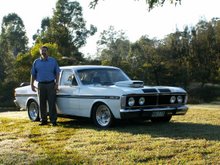
Car for sale 2


This ute belongs to one of our members and it is listed on eBay at:


Monday, April 02, 2007

Information Literacy

Report: Students struggle with information literacy
Justin Appel, Assistant Editor, eSchool News
November 28, 2006

Many students know how to use technology, but fewer know how to apply it to find what they're looking for
We often think of today's students as technology-savvy--and while that might be true, to a certain extent, when it comes to using hardware and software devices, a recently published report shows how little know-how students display when it comes to information literacy, or the ability to use technology to find the information they're looking for.
The report, from Princeton, N.J.-based ETS, found that the majority of high school and college students lack the proper critical thinking skills when it comes to researching online and using sources.
The report comes from an evaluation of the responses of 6,300 students from 63 institutions around the country to ETS's new ICT (Information and Communications Technology) Literacy Assessment. Students were given scenario-based items that were presented to them in 75-minute test environments. These information literacy tests included extracting information from a database, developing a spreadsheet, or composing eMail summaries of research findings.
The tests are meant to measure students' abilities to overcome three challenges they typically have: "The ability to identify trustworthy and useful information; "The ability to manage overabundant information; and "The ability to communicate information effectively
The study found that 52 percent of those tested could correctly judge the objectivity of a web site, and 65 percent could correctly judge that web site's authoritativeness. But only 40 percent of students entered multiple search terms when researching a topic, and only 44 percent properly identified a statement that captured the demands of the assignment.
"We have a kind of wake-up call that's being presented to all of us at this time," said Mary Ann Zaborowski, executive director of product management with ETS. "When we think about students today, they're the millennium children. They've grown up around technology. They've been automated with all kinds of computers, cell phones, digital cameras, music. They're more well-versed than any of us who preceded them in terms of how to use these devices. But where there's a startling gap is in their ability to cognitively apply this technology in meaningful ways."
I'm not surprised. I think it's not just a problem specific to a region," says Della Curtis, coordinator of library information services for Baltimore County, Md., Public Schools. "I think it's a national issue, for which there have been many organizations that have prepared reports on 21st-century literacy, from way back."
One of the problems, Zaborowski points out, is students' over-reliance on search engines such as Google when it comes to researching topics. The study found that students typically will type in a search keyword, then simply go to the first search result and use it as an authoritative source. The problem with this approach is that a number of top search results on Google are often slanted or biased. Through a process known as "Googlebombing," people can alter the top results for a search term. For example, when you type the word "failure" into Google's search engine, the top result that appears is the White House biographical page for President George Bush.
ETS hopes educators can learn from its report. School leaders "can use the results to identify the misconceptions that faculty might have about the competency of their students," said Zaborowski. Then, she said, educators can "build a consensus on revisions to their curriculum to address those gaps."
Many school districts, such as Baltimore County, are already aware of the information-literacy challenge. To address the problem, Baltimore County has been producing a web-based curriculum that, according to Curtis, "raises the bar on student research and problem solving."
Through this web-based curriculum, Baltimore County has put together a number of research models for elementary, middle, and high school levels. Each research model has a different scenario and task that students must complete. Students are directed to resources the school system has evaluated, which will help them answer key questions. These resources point students in the right direction when it comes to search methods.
"We feel that this is an effective strategy in integrating information literacy ... within the context of the curriculum," said Curtis.
Although schools strive to improve their students' information literacy skills, educators must take concrete measures to ensure students have the critical thinking skills they need to find information online, according to the report. "Access to information is becoming a goldmine or landfill," said Curtis. "We need to develop strategies to integrate information and communications literacy skills within the context of the curriculum."

Tampax

His pediatrician asked six-year-old Johnny, who watched a good many TV, adds, just to make conversation. Johnny, if you found a couple of dollars and had to spend them, what would you buy?”
“A box of Tampax,” he replied without hesitation.
“Tampax?” said the doctor. “What would you do with that?”
“Well,” said Johnny, “I do not know exactly, but it’s sure worth two dollars. With tampax, it says on TV, you can go swimming, go horseback riding, and also go skating, any time you want to.”

Car for sale 1


This car belongs to a friend of one our members and it is for sale.


email me for more info on:


gnobl2@eq.edu.au